Sunday, 13 October 2013

Oral How-giene


This may sound like a very broad and very obvious topic. Sadly over my relatively minimal tenure in the dental profession I have come across many abominations of the aforementioned topic.

The problem usually begins with a simple question: “so, how often a day do you brush your teeth”. At the beginning of my studies I believe my emphasis was on “a day” assuming that most people would abide by the twice a day brushing rule. Sadly these people were in the minority.

 I then reassessed my questioning technique and modified to “how often do you brush your teeth”. I was met frequently with, “errr I’d say around twice a week”.

Just to put this into some sort of context a have created a week-to-view calendar of this patient’s oral hygiene habits.


Again, just to emphasise the point this would involve, going to bed, waking up, going to bed, waking up, going to bed, waking up, going to bed and waking up WITHOUT CLEANING YOUR TEETH.

Of course there are many combinations of the above diary and I have just highlighted one, of course said patient may have a special gathering on a Wednesday so they may rummage behind the sofa and whip out their brushing implement (I avoid using the word toothbrush for reasons described later) for this exceptional event upping their weekly mouth cleaning total to 3.

I realise sadly I am a special breed of person who struggles to have a glass of water without feeling like my teeth are covered in fur, but surely this must feel AWFUL. What is often shocking is these people are in attendance of their dental appointment with a partner. Someone who presumably gets within a close vicinity of said mal-brusher. I will leave your mind to fill in the rest.

After realising that the majority of people neither brush twice daily, nor use a toothbrush I have modified my questioning to “so, what is your cleaning routine for your teeth” which usually gets me the response I am after.

I have also encountered a realm of instruments and methods used for cleaning teeth. From sticks (“Jesus used a stick so must be good enough for me”) to brushes which only could have been designed for horses.

As I have mentioned before, I am not sponsored by anyone or anything (I can’t imagine why) and so my advice comes not from a monetary fuelled avenue. Whilst I enjoy a gadget and thus use a Sonicare toothbrush, this was given to me free are charge during University when our young student minds were easily swayed by freebies. You can pick up toothbrushes for 9p. Yes that’s right, 9p. I just checked. Look. http://www.tesco.com/groceries/Product/Details/?id=256420940. They do pretty much the same job. Strangely enough saying this, I have only encountered one person who used cost as an excuse for not brushing.

A few of my personal favourite excuses, alongside those I have borrowed from other colleagues’ horrific reports are recorded below.

“I used to have great teeth but they wouldn’t let me take my electric toothbrush to jail”

“My previous dentist told me brushing damaged the gums so I don’t bother anymore”

“My gums bleed when I brush” This excuse isn't so comical and I will cover later on in another post.

“My brother flushed my toothbrush down the toilet” (which warrants the question how powerful is your toilet flush!?)

“My toothbrush broke”

“I get up very early and the sound of my electric toothbrush wakes up the kids”

Apparently the excuses don’t stop at the brushing implement itself.

“I just don’t like the taste of toothpaste”

"My dad took the toothbrush to work so I couldn't use it"

“I’m allergic to fluoride”

"No one told me I was supposed to clean my teeth"

“I don’t have time” – this is often said by a woman wearing make-up so thick that could only be removed using a wallpaper stripper

There are some people who get away with not adequately cleaning their teeth. Sadly the majority of poor mouth-cleaners are those who also believe losing a filling and leaving it for 5 years won’t cause any detrimental effect. Please refer to previous blog post for my feelings on this. These people of less-than-socially-acceptable plaque carriage are also the ones who enjoy the following rant:

“I don’t understand why my teeth are so rubbish. They just aren’t formed right I don’t think. When I was pregnant they just crumbled/I fell off a bike when I was 37 and they’ve never been right since/they just fell apart. My sister/brother/dog has lovely teeth and I just don’t understand why I’m so unlucky”.

Post-rant actual advice

1. Brush twice a day. Yes. Brush. With a toothbrush. If you use the right technique which any dentist or hygienist will be able to show you it doesn’t really matter whether you use a manual or electric toothbrush
  • I personally feel electric toothbrushes are easier to use. You can’t apply too much pressure and for people with manual dexterity problems or who suffer from laziness it does the work for you. At this point I could insert various studies and "clinical trials" showing results of manual vs electric toothbrush contests. Sadly 99% of these are sponsored, conducted, altered and generally biased by the dental trade. I.e. Oral B pay for studies to be done about Oral B. Same for Sonicare etc etc. Therefore it is not wise to read to much into this. As a general guide, it is what feels comfortable to you. Some people despise sonic toothbrushes, I personally very much enjoy mine.
  • If however you are going to venture into the world of dental gagettery, then I would recommend the following. Invest. This does not mean spending a fortune. In fact Boots and the like have offers on the Oral B brushes all the time and do an extra special offer around Christmas time (generally knocking off 50p more than in all previous months). In saying this, I mean stay away from the toothbrushes that are basically a manual brush with batteries in. They will do nothing more than your normal brush but cost a lot, and the toothbrush heads also cost a lot more. 
  • With the example of Oral B brushes, the Oral B 1000 does pretty much what the Oral B 5000 (and I've just noticed they have added the word "Triumph" to their latest brush name - fancy). The difference is a clock with a smiley face - something I'm sure a little home arts and crafts could conjure up, and a few "free" brush heads. Considering the difference in price is about 70 pounds, these free brush heads seem to have a significant mark up to the ones you can buy separately.

2. Use a toothpaste with fluoride. At least 1450ppm. It will say this on the side of the box - usually as something fluoride (the something usually being sodium or potassium). Even the really inexpensive toothpastes pretty much all have a good level of fluoride in. (N.B this is the recommended level for adults, children are a different matter. We can also prescribe much higher levels of fluoride if we think you are at a higher risk of getting tooth deca

3. DO NOT RINSE AFTER BRUSHING. The reason we recommend a fluoride toothpaste is because fluoride helps stop bacteria in its tracks. It also hardens the tooth structure. If you wash this off, you pretty much counteract using a toothpaste and so might as well just use a brush and water. Or a stick in fact

4. Mouth wash. This is a tricky one. I like to view mouthwash as a personal preference type thing. Unless we recommend mouthwash as an aid in fighting gum disease (in which case chlorhexidine is the only thing with any proven efficacy), for dry mouth (something I will happily write about if anyone wants advice) or for orthodontic patients (who require more meticulous oral hygiene because they have blobs of metal and Hanibal Lecter type head gear) there is no particular reason for using mouthwash other than to freshen breath.

  • We would always recommend an alcohol free mouthwash purely because the less alcohol you can expose your delicate mouth to the better (due to its cancer inducing properties – I’ve put this in brackets so it hopefully makes the “cancer” word less terrifying)
  •  If you’re going to use it, wait at least 30-60 mins after brushing for the same reason we say don’t rinse. Ideal would be to rinse at a completely different time of the day so that your teeth are getting another hit of fluoride. Its a bit like applying moisturiser straight after you've already put some on. Its not going to do any harm and it will probably make your skin feel nice, but not as nice as if you wait a few hours and reapply. 
  • If you have been recommended to use chlorhexidine this is slightly tricky. Certain ingredients in toothpaste – namely the ones that make it foam – in-activate the stuff in chlorhexidine that makes it work. Sadly it also doesn’t work if there is too much of a plaque layer on your teeth. Therefore pinpointing a time to rinse when it will be effective is tricky but I would say if you are within the 30-60 minute window I mentioned before you should be safe
  • For the aforementioned orthodontic (brace wearing) people, or for those who are deemed "high risk" for dental decay - which your dentist can discuss with you - there are a plethora of fluoride mouthrinses. Whilst your dentist can prescribe some which will have a higher concentration of fluoride, you can also pick them up over the counter.

5. Tooth brushes DO NOT clean in between teeth. Gum disease is caused by a build-up of bacteria in between the teeth and below the gum line. The bristles of your brush (or splinters of your stick if you are so inclined) are far too big to get to this area. Therefore to effectively clean your teeth you need to be flossing or using interdental brushes like TePe’s. (I will be writing a separate post about gum disease to explain this in more detail but you get the jist)


I hope this makes sense and that you have picked up some pointers amidst my general annoyance at the general population for their lack of oral cleanliness. In all honesty I should be grateful as it keeps me employed however it would be nice not to feel the need to wear 3 masks and hold my breath to protect me from the halitosis I encounter on a daily basis from whichever dental chair I am leaning over. This is of course not an exhaustive list. There are many other things you can do to get optimum oral hygiene. There is also a lot more you can do to reduce your chances of getting tooth decay and I can of course cover this at a later date. This post is more of a baseline for improving your hygiene rather than the be all and end all of dental decay prevention!


As always, please feel free to ask any questions about toothpaste, toothbrushes, brushing techniques etc etc.

Dental Prevention Toolkit. 
This is a very long document aimed at toothworkers however if you have any confusion over what brand of toothpaste/mouthwash contains what ingredients then it is very helpful. 
Below I have provided a bit of a modified contents page of things that might be useful. 

Page number
What you’ll find there
20
Names of toothpaste brands with the amount of fluoride they contain
25
Diet related stuff to help reduce your risk of getting rotten teeth
29
Lists of sugar free medications – they usually say sugar free on the box and most good pharmacists will know which medicines don’t have nasty sugar in, but it is a helpful guide if you’re not sure
There is generally a lot of helpful information in this whole document but I’m hoping there will be very few of you that will rifle through all the jargon as it sort of invalidates the reasoning for me writing this blog so, for my sake, please continue to visit smiles—better!


Monday, 7 October 2013

Root canal treatment. Run for cover or run to the dentist?

Today's topic to be tackled is the touchy subject of root canal treatment. 

It seems to be that whenever the notion of this is mentioned to a patient they turn pale, clammy, and leave me reaching for the medical emergency drug kit. Sadly I believe along with smear tests, the MMR vaccine and Marmite, this tooth-saving therapy has been the victim of many misconceptions and media scare mongering. 

Most often I am met with "but that hurts doesn’t it?" "my cousin/friend/that woman off of *insert American sitcom here* had one of those done and they didn't get out of bed for a year" and whilst anything that requires prolonged and/or regular contact with one of us tooth workers is never the top of anyone's bucket list, it is very far removed from the nightmare people make it out to be. 

The technical bit

Again with a little help from my friends at nhs.uk a handy definition goes a little like this....."Root canal treatment is a dental procedure to treat infection at the centre of a tooth (the root canal system). Root canal treatment is also called endodontics". Professionals in the field of root canal treatments are therefore called endodontists and there may be certain situations where you need to see one of these. 

Why you need it:

Below is an x ray of some teeth (taken from www.dentistryunited.com). Just as a side note, us tooth workers refer to x ray pictures as "radiographs" so when you hear us bandying this around thinking we sound fancy, now you can nod along. 


I have added some very technical labels as you can see. 

For some reason - usually due to decay, leaking around fillings over time or due to shoddy dental work - the nerve of your tooth becomes inflamed and infected. (You may hear the nerve being referred to by us dental folk as "the pulp")

Please note: This is just one of many scenarios that lead to the need for root canal. You may also require it for things like trauma - falling off your bike, drunken brawls etc - but the basic principles of why root canal is necessary remain the same. 

At this point you may experience some sensitivity. In some cases people experience no symptoms at all but 99% of the time the story goes something like this:

 "I was in agony for a week but then it went away so I thought it was fine"

It will never be fine. There is a reason it hurt. The reason is that your nerve is dying off. 

During the nerve's demise, a tonne of bacteria and toxic chemicals from the necrotic (fancy word for dead/dying/rotten) nerve leak out the end of the tooth and start to eat away at the bone. This causes a dark area at the end of the root on an x ray (see above) and is often what leads to an abscess, or at least it has the potential to become an abscess. 

If this area of infection is left for a period of time, you may experience a lump on the gum, which feels like a blister or a gum boil, or simply a swelling of the face. This is because the infection is trapped within the bone of the jaw and has nowhere to release itself so it causes swelling. A bit like filling a balloon with water, or a really painful spot that hasn't developed that nice white head yet. 

At this stage, when the nerve has died completely, nothing except root canal work or taking the tooth out (extraction) will solve the problem. 

Yes that's right - antibiotics will not cure the problem. They help settle the infection so we can tackle it more effectively but they will not remove the cause. No. Not even bucket loads of the things will make a difference long term.

I can also advise at this point that there is almost a 100% guarantee that the time you will realise this fact is when your face balloons up (a little akin to when the Nutty Professor's magic potion wears off and he turns from Buddy Love to Sherman Klump) on Christmas Eve/New Years Eve/before you go on holiday. Sadly at these times myself, my colleagues and our non-oversized features will be eating/drinking/sunning ourselves/laughing about that person WHO THOUGHT THEY COULD GET AWAY WITH JUST ANTIBIOTICS.

The actual (post rant) technical bit.

The root canal/canal/where the nerve lies in the tooth is where we have to get to in order to do a root canal filling. The basic principles for a successful (in the eyes of our superiors who write guidelines) root treatment is to:

1.
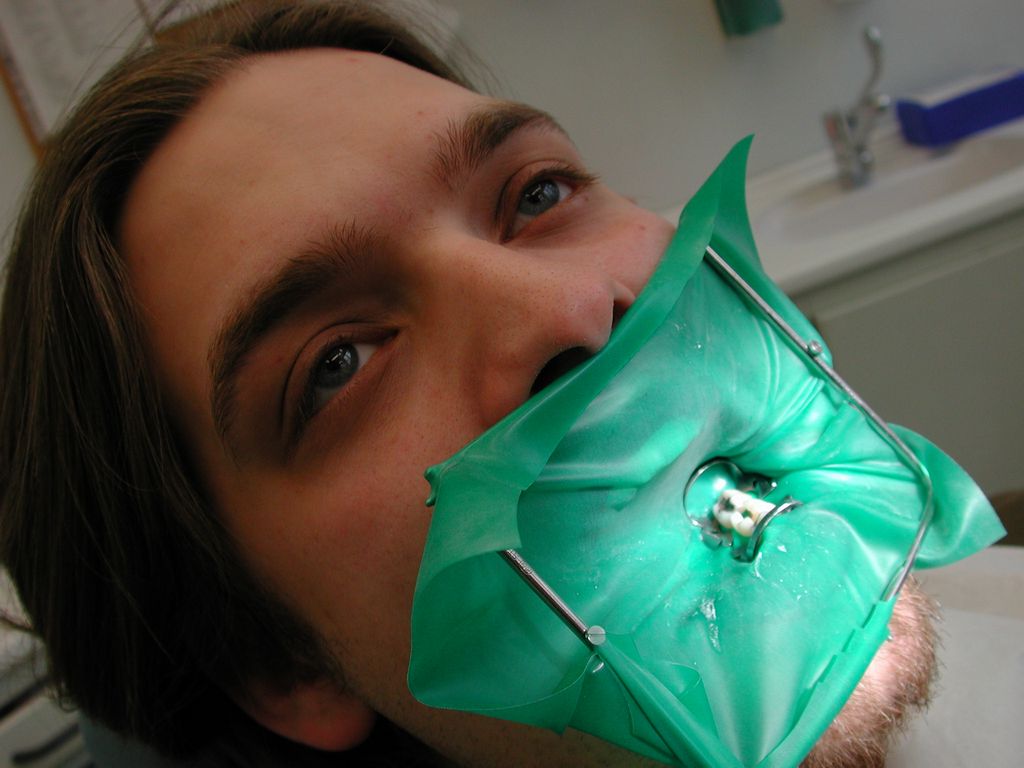
Remove all the infected/dead nerve and bacteria from within the tooth. This is aided using certain disinfecting chemicals. For this reason, during treatment you will have to wear one of these:


Apologies for the morbid expression on this gentleman's face, I imagine inside he is feeling pure joy. 

The green sheet/frame/silver clamp around his teeth is referred to as a "rubber dam" (referred to by my Dad for several months as "a Ramadan" - yes the famous Islamic period of fasting - because apparently "that's what it sounded like when the dentist explained it")

Wearing this device means that your mucky bacteria-containing saliva doesn't get inside the nice clean tooth and re-infect it. Similarly it means that whatever chemicals we use to make the tooth squeaky clean go nowhere near the inside of your mouth. It also makes the whole process a lot more comfortable. As you can see, you also look pretty glamorous.

2.
Shape the canal where the nerve resided to a nice even conical shape with no ledges where bacteria can continue to breed. This is done using an endodontic file. These come in many shapes and sizes. They may be held by hand, or be used in a machine.

3.
Fill the canal COMPLETELY. This is the tricky bit. As you can imagine these pesky canals are very small and in order to make sure the tooth does not become reinfected, the tooth needs to be cleaned and filled right to the end of the root. 

Maybe this picture will help. 

Pic


The picture above shows a tooth with 2 roots and 2 root canals. There are generally a set of anatomical rules for teeth and root canals however as with everything in the human body, this is open to a lot of individual diversity. 
For example, upper front teeth usually have one canal and it would be very unlikely to find a front tooth that varied from this rule. However, upper first molar teeth for example should technically only have 3 root canals (one for each root) but we often find that they have 4. Similarly, for lower molar teeth, these have 2 roots but 3 root canals. 
As you are beginning to see it is quite a complicated process. 

Root filling done, what happens now

Often comes the question of what should be done with the teeth following completion of the "root canal filling" bit. Again this varies depending on which literature you read. In fact there is such debate in this field (oh yes, quite the hot potato of the dental world) that even the Cochrane review on this topic concluded "there is insufficient evidence to support or refute the effectiveness of conventional fillings over crowns for the restoration of root filled teeth". Which basically means, no one can come to an agreement. 

What cannot be refuted however, is that the tooth needs to be adequately sealed after root canal treatment (fortunately a number of scholarly people agree with this - Saunders and Saunders 1994) and in fact even way back in 1990, Torabinejad and his friends found that it only took 19 days for the entire length of the root canal to be reinfected if an adequate filling was not placed following root canal treatment. 

What this means is plain English is that you can't get away with having a root filling done and then live with a naff temporary filling for several years, or in fact months. 
If your dentist is planning on placing a crown on the tooth (which is perfectly reasonable), ensure that a good quality filling is placed, this will not be soft or crumbly. If they give you a temporary crown while your permanent one is being made, it needs to fit well, and if it falls off it should be replaced or recemented immediately. 

Finally, whilst I say this is one of the 2 options for dead (non vital in science speak) teeth it does not guarantee 100% success. This means the following:

1) If your face resembles that of the elephant man, this means there is a whopping great infection at the root of the tooth, and while we could clean it and fill it to textbook perfection, the infection means there is a reduced chance of success
2) Even if you are the "perfect" candidate for root canal treatment (e.g. an infection caught early, nice wide root canals etc) and the root filling is a thing of beauty, this does not mean the tooth will last for the entirety of your days on the planet. At best it can extend the life of the tooth for several years. Some people are very lucky and it may even outlast your human self. Others sadly find it becomes reinfected down the line however at least it buys some time so you can save up for whatever tooth replacement option you fancy. 

"Lazy dentist syndrome"

As I mentioned above, canals are very tricky to negotiate and in some cases even find. Imagine the M6 on a Friday night at rush hour/that country pub in the middle of nowhere that you thought you would try and find. 

On an x ray rather than seeing a nice black line down the centre of the tooth/root as you can in the x ray I put up earlier, you may not be able to see anything. This is due to the fact that the canal(s) have "closed off" or become blocked due to a number of things such as the natural aging process, the infection itself, previous trauma etc. We call this "sclerosis". 

In these situations a specialist endodontist would be the absolute best person to treat you and a referal to such a person can be made by your dentist. 

Sadly I have encountered several patients referred to my place of work with canals the size of the channel tunnel because apparently "no one in the practice is qualified to do root canal", I would therefore suggest you raise the question "at what point was this removed as a necessary examinable requirement OF EVERY QUALIFYING DENTIST IN THE COUNTRY".  

I am not going to go into the many clauses and stipulations of the NHS contract as it is interpretable in many ways. Each dental practice will have their own rhyme and reason for treatments they provide. They may only provide root canal therapy on a private basis however every dentist is qualified to carry it out and in my opinion should at least provide you with an honest opinion and offer to "have a go" or show you on an x ray why they believe it is not feasible for them to attempt root canal (e.g. due to sclerosis). 


Final bit of advice

As you can see, I have been rambling on for many many lines now and could continue for many more about root canal treatment (because sadly I find this all very interesting) however my final pieces of advice are:

  1. Please don't wait until you are in agony to go to the dentist
  2. If your filling comes out with your bacon sandwich, it will not be fine, it is never fine, please go to the dentist to have it fixed
  3. Root canal fillings are an excellent treatment option and are frequently the only means of "saving your tooth"
  4. They however are not 100% in any cases because your tooth is already pretty messed up from the whole rotten tooth thing
  5. Therefore, please brush your teeth and keep the sugar exposures to a minimum. 
As always, ask ask ask away. If you have made it to this point I congratulate you. That's at least a years worth of lectures in one blog post. Maybe I could appeal to make it some sort of verifiable CPD......

References:


Fedorowicz Z, Single crowns versus conventional fillings for the restoration of root filled teeth.Cochrane Database Syst Rev. 2012 May 16;5

Saunders WP, Saunders EM (1994) Coronal leakage as a cause of failure in root anal therapy: a review. Endodontics and Dental Traumatology 10. 105-8

Torabinejad M. Umg B. Kettering JD  (1990) In vitro bacterial penetration of coronally unsealed endodontically treated teeth. Journal of Endodontics 16. 566


Thursday, 3 October 2013

Herpes. Nuff said.

It has come to my attention after having to rebook many patients attending for routine dental care with cold sores over the years, that maybe the infection has been misunderstood and so I thought seeing as it appears to be the time of year (a month I joyfully name "Herptober") where many of the public are being afflicted by said sorrow-causing virus that it would be topical for me to write a post on the subject. 

Anyone who knows me, has met me, has heard me scream or run across the room in horror when I encounter the above topic in the flesh will already have an idea of my opinion on the wonder that occurs on activation of the Herpes Simplex Virus. 

Of course I am referring to the "common" cold sore. According to nhs.uk "Cold sores are small blisters that develop on the lips or around the mouth. They are caused by the herpes simplex virus and usually clear up without treatment within 7-10 days." Although other sources will quote a longer time span of up to 14 days and I would heavily debate the definition "small blisters". 

My hatred and sheer phobia of the cold sore became such an undeniable fact that a colleague thought it appropriate to simply "give me Herpes" as a Christmas present. Now before your minds start whirring away on this information see below:


Yes, the above are in fact cuddly representations of what the Herpes Simplex looks like under the microscope. I am sure most will be in agreement that the above have a strange "cute appeal" to them, however in real life these little blighters are incredibly contagious and whilst they are hideous for the person whom they afflict they can cause some serious issues for health care workers including us dentist minions as well as having the potential to cause further misery to the owner of said blister following dental treatment. 

Complications of coldsores in the dental setting

Small disclaimer - please note this applies to only non urgent dental treatment and each case would be analysed separately on an individual risk benefit basis. 

Firstly, in the interests of fulfilling my GDC responsibilities of working in the best interests of the patient, carrying out dental treatment with a highly contagious cold sore outbreak can lead to spread of the virus around the patient's face and in a small number of documented cases it has even been found to cause nasty lesions on the neck and so not only is the following advice protective to myself but also to anyone we treat. 

This is where the science bit comes in (sorry).

Sotiriou et al. suggested that dental drilling procedures cause saliva to be made into such small droplets that they take on an aerosol form (like your deodorant or hairspray) and these particles are small enough to penetrate deep into the lungs. Which means they can also spray across the room and land on the person we are treating as well as ourselves. This point is echoed by Bentley et al. who measured the distribution of spatter and aerosols generated by dental drills (a thrilling task I'm sure) and found that contaminated aerosol droplets travel a high distance (up to a metre and a half away from the spot marked x) and linger there. Finally Checchi et al.showed that exposed areas of the dentist's face are at risk with contaminated particles.

What this means is that treatment of someone with an active coldsore (most contagious when it is at the nice crusty oozing stage) means risk of more coldsores occurring both on the patient and on us poor toothworkers. 

More seriously is a condition called "Herpetic keratoconjunctivitis". Nhs.uk describes this as "a secondary infection of the cold sore virus that affects your eyes [which] can cause inflammation (swelling and irritation) of your eye area and sores to develop on your eyelids...Left untreated, it can cause the cornea (the transparent layer at the front of your eye) to become infected, which can eventually lead to blindness". Whilst the glamourous protective goggles we insist both the patient and ourselves don during treatment have some role in preventing the aforementioned splatter droplets contaminated with the virus entering our eyes, they are sadly not impervious to everything. So bad news all around really considering that they make you look like you've walked right out of a year 10 chemistry lesson and don't protect you from the Herpes. 

Therefore, please understand that from tingle until the cold sore is completely gone PLEASE DON'T GO TO YOUR DENTIST (or anywhere near me in fact, I am considering appealing to the government for some sort of immediate restraining law should one be within in 500ft of me) unless it is an emergency as it can make it more miserable for yourself as well as the person happily drilling away at your teeth. 

As always, feel free to ask any questions or comments in relation to this. I am now going to douse myself with alcohol gel as even discussing the topic is making my lip tingle. Perhaps a hazmat suit might be a considered purchase for next Herptober.... 

References (apparently you can take the girl out of academia but can't take academia out the girl)
ONLINE RESOURCE www.nhs.uk

Bennett AM, Fulford MR, Walker JT, Bradshaw DJ, Martin MV, Marsh PD. Microbial aerosols in general dental practice. Br Dent J. 2000;189:664–7.
Browning A Case Series: Herpes Simplex Virus as an Occupational Hazard J Esthet Restor Dent. 2012 February; 24(1): 61–66
Essman J. The many challenges of facial herpes simplex virus infection. J Antimicrob Chemother.2001;47:17–27. 
Miller C, Redding S. Diagnosis and management of orofacial herpes simplex virus infections. Dent Clin North Am. 1992;36(4):879–95.
Netatidanesh Risk of Contamination of Different Areas of Dentist's Face During Dental Practices Int J Prev Med. 2013 May; 4(5): 611–615.
Prospero E, Savini S, Annino I. Microbial aerosol contamination of dental healthcare workers’ faces and other surfaces in dental practice. Infect Control Hosp Epidemiol. 2003;24:139–41
Szymanska J. Dental bioaerosol as an occupational hazard in a dentist's workplace. Ann Agric Environ Med. 2007;14:203–7.
Williams GH, 3rd, Pollok NL, 3rd, Shay DE, Barr CE. Laminar air purge of microorganisms in dental aerosols: Prophylactic procedures with the ultrasonic scaler. J Dent Res. 1970;49:1498–1504

Wednesday, 2 October 2013

My first post (hopefully not my last!)

And......deep breath......

Welcome to my blog, named in honour of my Dad who always wanted me to get a "proper" job in a dental practice which would have the pun-tastic name "Smiles Better". Unfortunately this is about as close as he's going to get to me owning something so here goes.

My name is Michelle. I am a 24 year old dentist/tooth worker.

After completing my training at Leeds University encountering my fair amount of "oh you're studying dentistry, do you want to be a dental nurse then" I went on to complete a year in general practice working away under the NHS contract with a bit of private tooth stuff thrown in and I am currently on a rotation (called DF2) working in the hospital setting. So whilst I am still a (very) junior member of the dental team I have seen the industry from various different angles and am keen to keep up with new innovations and ideas.

After being asked by several family members and friends to interpret charts given to them by their own dentists or to explain why they need certain treatments, along with a fair amount of "polite tellings off" of other special people in my life who perhaps decide that each mouthful of food should be washed down with Diet Coke ("It's diet, it can't be bad can it?") I thought it might be an idea to start some sort of online resource for other people in the same situation.

I therefore welcome anyone to comment with dental questions, queries, things they would like clarifying and I will do my best to ease your minds as well as throwing in the odd rant about issues close to my heart now and then.

Unfortunately now I have to add a subtle note...

DISCLAIMER
Any comments made on this blog are solely my opinion unless I reference otherwise. If I cannot provide objective answers on my own knowledge alone I will do my utmost to find reputable sources to do so. While I hope these comments do not cause offence I apologise if anything I say upsets anyone reading. I am not sponsored by anything dental and so any product recommendations are purely down to literature research or my personal trial and error. 

Now back to the post.

I have no idea whether anyone will read this, if anyone reads it how helpful it will be or whether this is my first and only post but I do hope that I can at least provide some comfort to at least one person who understands their mouth a bit better after reading.