Showing posts with label Dental. Show all posts

Wednesday, 18 December 2013

My current rant topic: E Cigarettes

Even the writing of the above “product” as a title offends me. For those who have managed to bypass the tsunami of people walking the streets/sitting on public transport/your favourite restaurant with what looks like a tiny musical flute sticking out of their mouth, e cigarettes are the new “cool” way to smoke.
They are advertised as being the best thing you can do for your health and from the sheer volume of marketing bumph surrounding them you would think they were some sort of miracle that purified even the finest mountain air.

In this blog post I will therefore attempt to work out
1)      What the hell they are
2)      What the hell is in them
3)      Why the hell people think it is acceptable to use them like a lollipop


The premise of the e cigarette is that it is supposedly a healthier alternative to regular cigarettes because they do not contain tobacco. This sounds all well and good as we know the damage that tobacco can cause – in particular reference to my area of “expertise” it can lead to a whole range of oral cancers which can involve not just the areas of your mouth visible when you yawn but a whole realm of other areas in the head and neck. Most brands of this device also claim that they do not contain tar. Another benefit of course unless of course you wish for your lungs to look like the surface of the M6.
They were primarily designed as an addition to the realms of nicotine replacement therapy (NRT) alongside patches, gum, medication like Champix etc and therefore used to cut down smoking.
All of this sounds very positive, so much so that one lady who switched to using a certain brand of the e cigarette to write the poem below:

No more cigarettes for me
What could I do, I liked the taste
Went to e-cigarette with much haste
Cigarettes without the bad bits
Made it easy to kick the habit
They come in lots of different flavours
For me to try and quickly savour
The prices are great
Delivery is never late
So give Smokers Angel a go
And try their range of Halo

Now that is quite a gushing testimonial. Similarly, the woman below appears extremely pleased with her e cigarette. It has even managed to get her a gentleman willing to photobomb her holiday snaps.  What could possibly be so bad.


On that note, let’s see if we can find any information at all about what is in them. Now trust me, I spent a good few hours trying to research this and the only thing I consistently came across was marketing BS. So I turned to the BMA (as I so often do)

What are they?

“E-cigarettes are battery-powered products designed to replicate smoking behaviour without the use of tobacco – some look like conventional cigarettes, while others appear more like an electronic device”  They consist of a cartridge containing liquid nicotine, an atomiser (heating element), a rechargeable battery, and electronics.

E-cigarettes have been marketed as cheap and healthier alternatives to cigarettes as well as to look and feel like cigarettes for use in places where smoking is not permitted since they do not produce  smoke. E-cigarettes are products operated by a single use or rechargeable battery that heats a liquid based solution (often containing nicotine) into a vapour. This is then inhaled by the user, simulating the effect of cigarette smoking.

They are primarily used (apparently) as a means to quit smoking and therefore the major studies conducted on e-cigarettes have analysed nicotine content, as addiction to this apparently why people cannot quit smoking. “An analysis of the total level of nicotine generated by e-cigarettes which vaporise nicotine effectively found that the amount inhaled from 15 puffs was lower compared with smoking a conventional cigarette”. Please note the extremely vague wording used by the usually extremely un-vague British Medical Association. Another study analysed sixteen e-cigarette brands and found the total level of nicotine in vapour generated by 20 series of 15 puffs varied from 0.5 to 15.4 mg. Again, there is no regulation, nor any standard or reproducible results that can be produced from e cigarette testing.

In 2009, the United States Food and Drug Administration (FDA) released results of an analysis of some e-cigarette product, it showed that the tested e-cigarette cartridges contained carcinogens and toxic chemicals. Analysis of two leading brands by the FDA also revealed:
  • diethylene glycol (a toxic chemical) in one cartridge at approximately 1%
  • tobacco-specific nitrosamines (which are human carcinogens) in half of the samples
  •  tobacco-specific impurities suspected of being harmful to humans (anabasine, myosmine, and ßnicotyrine) in a majority of the samples


The tests also suggested that quality control was inconsistent or non-existent:

  • cartridges with the same label emitted a markedly different amount of nicotine with each puff
  • one high-nicotine cartridge delivered twice the amount of nicotine compared to a nicotine inhalation product approved by the FDA.

 i.e. the biggest food and drug regulatory body in the world cannot conclusively say that is in the products or what they give out.

See next subheading.

E cigarettes – the new enemy?

Whilst I absolutely cannot deny that any improvement on smoking normal cigarettes is beneficial to health in general and therefore oral health, e cigarettes are a dangerous realm to enter into.
The reason they are cheaper is because they are not taxed in the same way as regular cigarettes. Hurray, I hear you shout. Sadly, these taxes pay my wages in the NHS, they also put people off smoking because it makes it so darn expensive. Without this deterent what is to stop people continuing to pump dangerous chemicals into their bodies. Similarly, they are not regulated in the same way as normal cigarettes. For cigarettes to be sold they have to go through rigorous quality control, the same does not apply for e cigarettes. Due to this, we have absolutely no clue what is in them.
All that can be said is that they are not licensed as a medicine in the UK, and there is no peer-reviewed evidence that they are safe or effective for the purpose of helping to cut down smoking, as a “healthier” alternative to smoking or in fact any other reason except making you look like you’re smoking a marker pen.

The World Health Organisation document (which is 50 pages long I might add); WHO STUDY GROUP ON TOBACCO PRODUCT REGULATION raises further concern about the use of these products as nicotine replacement therapy. “Delivery of nicotine to the lung raises concern about safety and addiction that go beyond that related to currently approved NRT, concern…is associated with the probable exposure of the lung to repeated dosing, perhaps hundreds of times a day for many months, if these products are used as a smoking cessation aid, or for years, for smokers who use them as long-term cigarette substitutes”. That is to say, the delivery of nicotine directly to the lungs has never before been studied, and whilst manufacturers get away with using certain chemicals in e-cigarettes because they approved for human consumption, we have no idea of the effect they have when inhaled.

Most people who purchase and use e-cigarettes claim they do so as a means to cut down on smoking i.e. smoking cessation, instead of things like patches, gum and so on. Sadly, the World Health Organisation(WHO) who govern most of what we do in terms of medication, health choices, prevention etc state that “as of July 2013, the efficacy in using electronic cigarettes to aid in smoking cessation has not been demonstrated scientifically”. They tend to err on the side of caution as they are such a huge body of people of differing backgrounds and motivations that having a strong unified opinion on something is a difficult task. However, so unified was their opinion in this case that they recommend "consumers should be strongly advised not to use" electronic cigarettes until a reputable national regulatory body has found them safe and effective”. Nuff said.

The British Medical Association have also been forced to offer up an opinion on the damn things and their summary is not much more positive than the WHO. They state that “four out of five e-cigarette users continue smoking, and use e-cigarettes primarily as a substitute where smoking is not allowed” thus completely defeating the object of switching to e-cigarettes for a smoking cessation purpose. Again, the BMA agree, expressing their concern that e-cigarettes may undermine smoking prevention and cessation, as their use is likely to reinforce the normalcy of the smoking behaviour”.
This normalcy was nicely illustrated just last week when I walked past a patient sitting IN THE DENTAL HOSPITAL WAITING ROOM smoking one of these devices, regarding me with confusion at my anger with her behaviour. Similarly, the fact that the e cigarettes are generally quite aesthetically pleasing and gadgetty-looking means that people are far more likely to openly smoke them, and thus consume more nicotine than they would should they smoke their normal cigarettes, thus negating the intended purpose of switching.

Our Australian cousins also echo this. “Other unintended consequences of e-cigarette use include the potential to induce nicotine addiction in non- smokers or maintain addiction in current smokers who might otherwise quit. Furthermore, concerns have been raised that e-cigarettes may undermine the comprehensive indoor  smoking restrictions and smokefree air policies” and making it generally acceptable for people to be seen smoking after years of hard work aiming to make them feel as embarrassed about smoking in public as public urination – people still do it but its few and far between, although maybe I grace the wrong areas of town at the wrong time of night.

The National Institute for Health Care and Excellence (NICE) recently published new public health guidance backing the use of licensed nicotine products to help people cut down as well as stop smoking. However, these guidelines did not cover e-cigarettes. Again, without having to say it, I imagine several suited men sitting round a table and laughing at the concept of e-cigarettes even being considered in this category of something that they would advise or recommend as something of health benefit.

Now of course, I cannot complete an analysis of the use of this product without referring to the superpowers of the USA – namely the Food and Drug Administration department (FDA). They basically regulate everything that is consumed, injected or applied by our friend across the pond and thus you could argue, have probably become fairly used to seeing products come and go, and are unlikely to have any emotional response related to items they are asked to assess. So strongly therefore did the FDA feel about e cigarettes that way back in 2010 long before the e cigarette phenomenon reached our shores, they issued warning letters to a grand total of 5 electronic cigarette distributors for various violations of the Federal Food, Drug, and Cosmetic Act (FDCA) including unsubstantiated claims and poor manufacturing practices. What is more worrying is that the FDA only regulates products intended for therapeutic use i.e. as a nicotine replacement therapy, and therefore, if a company decides to purely register their e cigarette product as recreational, or a hobby based item, then it completely negates all regulation by any drug agencies. Still fancy puffing away on one of them?

Dental Impact

What most people don’t consider is the effect that smoking has on their mouth. Whilst smoking e cigarettes should technically reduce risk of oral cancer, the presence of carcinogens in most of the leading brand’s e cigarettes negates this benefit. Similarly, the main causative factor of smoking related gum disease is nicotine. As the e cigarettes are rammed with the stuff, they offer no benefit in terms of “the leading cause of tooth loss” (thanks Corsodyl). That is to say, puffing away on your e-cigarette is just as harmful to your gums as smoking regular cigarettes and so your path on the road to dentures is just as speedy. In fact the WHO state that 90% of the nicotine that people smoking e-cigarettes are so desperate to get into their lungs, is actually deposited in the mouth.

In Summary.

The Medicines and Healthcare Products Regulatory Agency in the United Kingdom reported that it planned to regulate e-cigarettes as medicines from 2016 when new European tobacco laws come into force so until then, it remains that we have no idea what e-cigarettes are. In my mind, used as a nicotine replacement therapy, i.e. to smoke less and less over a set period until smoking has been stopped, completely, is fine, so long as they smoke it miles away from me, not around children, and that the whole thing stops being glamorised.

What I trawled through in order to write this blog:

BMA, E-cigarettes in public places and workplaces A briefing from the BMA Occupational Medicine Committee and the Board of Science, March 2012
BMA calls for stronger regulation of e-cigarettes
March 2012 (updated January 2013) A briefing from the Board of Science and the Occupational Medicine Committee

Sunday, 20 October 2013

Wis-Dumb Teeth

Wisdom Teeth.

This seems to be one of the most common things "friends" ask about. Mostly in the form of "oh I have a friend of a friend who has been having problems from their wisdom teeth (I believe they call this "giving them jip" in local lingo) and they think they need them ripping out (another of my favourite expressions) but they're really scared so wanted me to ask you about it"

My usual response is, "let me see" to which they look around as if this friend of a friend has magically appeared, realise I have cottoned onto their game, and promptly show me. 99% of the time I can't see a thing (those lights and mirrors on sticks have their uses from time to time) and generally nod in agreement that they need to come out. Perhaps in future I shall direct them to this blog post.

What are they?

God bless NHS Choices.

"The wisdom teeth grow at the back of your gums and are the last teeth to come through. Most people have four wisdom teeth, one in each corner."

I would add that they are not always the last teeth to come through. So stick that in your pipe and smoke it nhs.uk. (Of course I do not in any way promote smoking and you will perhaps realise this in my next blog post).

Some people have no wisdom teeth, some have up to 4. It is likely in most people that 4 wisdom teeth will have formed but just not "come through". 

Dental Glossary:

Wisdom teeth are also referred to as "8's" as they are the 8th tooth along from the mid line. They can also be called 3rd molars. 

See the particularly helpful picture below, the man is even so kind as to point to said tooth. I have also rather patronisingly added numbers to the teeth. 


We refer to teeth "coming through" as erupting. So unerupted, means the tooth/teeth are not yet in the mouth. That is to say, they are lying somewhere under the gums. Partially erupted means the tooth is just poking through and usually covered by a flap of gum, and erupted means that the tooth is fully through in the mouth and we are able to see all of the top part of the tooth (the crown)

Here are another slightly condescending picture to explain:


I will explain partially erupted teeth and problems associated with them a little bit later on. 

It was in fact very difficult for me to find a picture of an "unerupted" wisdom tooth as they are all labelled "impacted" and there is a certain amount of confusion between the 2 terms even within the dental world. I used the incorrect nomenclature the other day at work and received a telling off so thus am bypassing the damage it caused to my perfectionist nature by writing it in this blog post as if its a mistake everyone makes. 

Unerupted means as above, that the tooth simply has not erupted, i.e. has not come through into the mouth. This can be for several reasons. As a child, when you lose a baby tooth and then there is a period of time before the adult teeth come through, this is usually because they are lying under the gum waiting for the appropriate time to come through which is most likely when your parents need to travel in a car with you for several hours, or board a plane, or sleep. This can occur with wisdom teeth. 

Sadly, because we are generally evolving (although some human beings seen at the Dental Hospital lead me to rethink the idea that this scientific process is ongoing in our society) to have smaller jaws, we mostly don't have room for wisdom teeth. Therefore they often struggle to come through, or erupt, normally. They may be tilted, lie sideways, or simply be wedged in against the next door tooth. This is when they are termed impacted. The tooth can be completely under the gumline – so you cannot see any of it, or it may have managed to poke through the gum slightly but then realise it’s stuck and cannot erupt any further (a bit like when you stick your head through a gap in the railings only to find you can’t then get out)
It is worth noting that is impossible to know which case you have – unerupted or impacted wisdom teeth - unless you take an x ray. Similarly, a tooth can simply be partially erupted because it is just too lazy to make a proper effort to erupt, or it can be because it is impacted and cannot move any more.

When it all goes wrong

When teeth are impacted the future can progress in a number of separate, or in fact a combination of, ways:

1) The teeth never attempt to come through because it’s just not worth their time or energy trying to push their way past an unmoveable blockage i.e. jaw bone, the adjacent tooth. In this situation the impacted wisdom tooth just stays where it is below the bone and you experience no problems at all.
2) The wisdom teeth cannot erupt for the reasons explained above, but instead remain positioned very very close to the 2nd molars (the number 7 teeth). For this explanation I require you to “suspend disbelief” (that English A level didn’t all go to waste) and imagine being on the Tube, or a nice ram-packed bus in rush hour. Picture the overweight sweaty man that you are just about managing to keep a safe distance from. Now imagine that it is no longer possible to maintain the space between you and his sweaty armpit and the two of you become wedged together.  This is a similar sort of thing to when wisdom teeth cannot erupt. You would of course be fine for a while, despite feeling a deep feeling of mortification, however say if you had to stay like that for months or years on end. Eventually things are going to get, shall we say, stagnant. In this way, going back to what I was meant to be discussing rather than my nightmare commute to work, it is not necessarily the wisdom tooth itself (in today’s production played by the sweaty man) that suffers from damage, but the adjacent tooth.
This can occur in a number of ways,
  •  If the tooth has managed to come slightly through the gum, as shown below, then it becomes almost impossible to clean around the back surface of the adjacent tooth, and so you can develop tooth decay in the second molar


Here is the same thing shown on an x ray -  which is often the only way we can detect a problem going on due to the close proximity of the molar teeth and our tooth worker abilities being limited to human only skills (although some like to believe otherwise).


  •  If the tooth is completely impacted i.e. it has not come through the gum/erupted into the mouth at all, the most common problem is that the wisdom tooth causes resorption of the second molar. (which is where the tooth or more importantly the tooth of the tooth, is eaten away, much like in those awful horror films where the busty blonde one gets attacked by some sort of flesh-eating bug – whilst I may add, her make-up and hair stays in pristine condition).


Apologies for the unclear quality of this x ray – it turns out that there is pretty much no visual evidence of this “resorption” being caused by wisdom teeth despite seeing it at the hospital on a weekly basis. The x ray shows a typical appearance of a second molar suffering from this resorption. Of course the wisdom tooth has been removed at this point because it was causing said resorption.


Partially erupted teeth

Whilst the above circumstances of decay or resorption due to wisdom teeth happen on a fairly regular basis, the most common problem with said intelligence-increasing teeth is something called pericoronitis. I have decided to give my good friends at nhs.net a break and have (perhaps blasphemously) borrowed this definition from medicinenet.com

Pericoronitis is a dental disorder in which the gum tissue around the (3rd) molar teeth becomes swollen and infected” To break the word down:
  • “peri” means “around"
  • The “coron” bit is a shortened version of coronal(ly) which refers to the crown of the tooth (the top bit that you see above the gum)
  • “itis” means inflammation/swelling (which is a good common bit of information, anything with “itis” after it means inflammation or swelling e.g. sinusitis, bronchitis)


So the word pericoronitis means, inflammation or swelling around the crown of a tooth. This therefore can occur with teeth other than 8’s – for example when children are teething, however it tends to occur most with wisdom teeth because they are so hard to get at anyway.

For pericoronitis to occur there has to be a certain set of circumstances:

  1. Your wisdom tooth should be PARTIALLY erupted. If the tooth is in its final position in the mouth i.e. has come through fully, then you cannot get pericoronitis and any problems or symptoms you are experiencing will be due to something else.
  2. For the reason above, the tooth will therefore be covered by a flap of gum
  3. Due to the flap of gum, it becomes very difficult to clean around the wisdom tooth effectively. It’s a bit like trying to hoover under the sofa. It’s doable but it takes effort.


        Here is a picture.


How you know you have it.

Your dentist will be able to tell you immediately but the signs and symptoms of periocoronitis are:
      1)    Pain from around the wisdom tooth – it can be upper or lower
a.    You will often be able to feel with your tongue that there is a flap of gum over the tooth and that pressing on this triggers the pain or feels sore
      2)    You may feel like you have pain in the jaw particularly if you try to stretch wide for example when yawning
      3)    Bad breath. I don’t mean morning breath I mean actual people-walk-out-the-room-when-you-come-in bad.
      4)    Accompanying the bad breath is often a foul taste
      5)    Sometimes you can also get swollen glands (because they are reacting to the infection/inflammation) or a generally swelling around the area of the wisdom tooth for example a lower left wisdom tooth with pericoronitis may present with a swelling of the lower left part of the face if it is left untreated

How to deal with it

Ideally, you should go and see your local toothworker as a lot of the above symptoms can also be caused by a lot of other things from the mundane tooth decay to something more sinister. However, if they are fully booked (i.e. have a rep coming at 12pm and they’re bringing free lunch so all emergency slots are cancelled) or if you cannot get to a dentist then there are a number of things that you can try first to relieve the pain. If these work then it will save you a visit to the dentist and the accompanying cost and time etc.
Having a partially erupted wisdom tooth alone will not lead to pericoronitis. There has to be the build-up of plaque under the flap of gum. Unfortunately this does not spare even those of us with a toothbrushing addiction or the possession of the “they should know better” degree. I had a nasty bout of it last week. Sadly you don’t realise you’re not cleaning effectively enough until it hits you.

Therefore, the action plan is as follows:
     1.    Clean the hell out of the area. (Pardon my French). Get your toothbrush round there, but more importantly you need to get under the flap of gum (which just for completeness is called the operculum).The best way to do this is with either a single tufted toothbrush – you may have one lying around, if not they are readily available to purchase from supermarkets or chemists – or if you cannot get out to get one, a cotton bud will do a good job

 
2.    Use chlorhexidine mouthwash. This is most commonly called “Corsodyl” mouthwash, because after university we tend to lose all concept of chemistry and medicine and just call everything by its brand name.
a.    Use this as a rinse whenever you can be bothered, but at least after eating. As a side note, do not do this for more than a week. This is for several reasons, the first being that if there is no improvement after a few days then it is unlikely using a mouthwash for a week is going to help. Also, chlorhexidine causes staining of the teeth if used continuously for longer than 7 day periods. This staining is easily removed via a scale and polish but it is best to avoid it if possible.
b.    It is also very helpful to dip the aforementioned single tufted brush or cotton bud in some chlorhexidine prior to cleaning under the gum flap

     3.    If this does not improve the situation then you really do need to go to your dentist. They will wash out under the gum more effectively than you can manage at home, and if deemed necessary i.e. if you have swollen glands, severe pain, pain that hasn’t resided, any difficulties opening or closing the mouth, then they can prescribe you some antibiotics. Generally we will give a drug called Metronidazole. As a prior warning, if you’re planning to go to the dentist on a Friday and then drink away your sorrows at the weekend, think again. Metronidazole blocks the production of a certain chemical/enzyme required for breaking down alcohol. Therefore should you choose to indulge in an alcoholic beverage or 2, you will be violently ill. I don’t mean standard-end-of-a-night-out ill, or even Freshers-week ill, I mean wanting to murder-the-person-who-discovered-alcohol-I-promise-I’ll-never-drink-again sick.

     This nicely leads into the wondrous and very much mistaken taking out of wisdom teeth. Sadly one bout of pericoronitis is not an adequate reason for extracting wisdom teeth. Nor is “well they just don’t do anything useful do they?”. In my next post I will go into the reasons for and against extracting 3rd molars/8’s/wisdom teeth, as well as the process itself and a few pointers to follow as I feel I have waffled on quite enough for one sitting.
     
     As always questions are more than welcome, as are corrections of blatant mistakes. General rudeness however will result in an internet-transmitted slap. 

    Bye for now!!


Where I “borrowed” info from

http://www.nhs.uk/Conditions/Wisdom-tooth-removal/Pages/Introduction.aspx
http://www.drvenmar.com/Impacted_Teeth
http://www.drjohnschmitz.com/images/wisdomTeeth_adjacent.jpg
http://www.thenextdds.com/uploadedImages/The_Next_DDS/Clinical_Images/02b%20Laskin.jpg
http://www.medicinenet.com/pericoronitis/article.htm
http://www.juniordentist.com/wp-content/uploads/2012/09/pericoronitis-pericoronal-pouch-or-operculum1.gif
http://blog.dentist.net/wp-content/uploads/2011/12/tepe-compact-tuft-toothbrush.jpg

Sunday, 13 October 2013

Oral How-giene


This may sound like a very broad and very obvious topic. Sadly over my relatively minimal tenure in the dental profession I have come across many abominations of the aforementioned topic.

The problem usually begins with a simple question: “so, how often a day do you brush your teeth”. At the beginning of my studies I believe my emphasis was on “a day” assuming that most people would abide by the twice a day brushing rule. Sadly these people were in the minority.

 I then reassessed my questioning technique and modified to “how often do you brush your teeth”. I was met frequently with, “errr I’d say around twice a week”.

Just to put this into some sort of context a have created a week-to-view calendar of this patient’s oral hygiene habits.


Again, just to emphasise the point this would involve, going to bed, waking up, going to bed, waking up, going to bed, waking up, going to bed and waking up WITHOUT CLEANING YOUR TEETH.

Of course there are many combinations of the above diary and I have just highlighted one, of course said patient may have a special gathering on a Wednesday so they may rummage behind the sofa and whip out their brushing implement (I avoid using the word toothbrush for reasons described later) for this exceptional event upping their weekly mouth cleaning total to 3.

I realise sadly I am a special breed of person who struggles to have a glass of water without feeling like my teeth are covered in fur, but surely this must feel AWFUL. What is often shocking is these people are in attendance of their dental appointment with a partner. Someone who presumably gets within a close vicinity of said mal-brusher. I will leave your mind to fill in the rest.

After realising that the majority of people neither brush twice daily, nor use a toothbrush I have modified my questioning to “so, what is your cleaning routine for your teeth” which usually gets me the response I am after.

I have also encountered a realm of instruments and methods used for cleaning teeth. From sticks (“Jesus used a stick so must be good enough for me”) to brushes which only could have been designed for horses.

As I have mentioned before, I am not sponsored by anyone or anything (I can’t imagine why) and so my advice comes not from a monetary fuelled avenue. Whilst I enjoy a gadget and thus use a Sonicare toothbrush, this was given to me free are charge during University when our young student minds were easily swayed by freebies. You can pick up toothbrushes for 9p. Yes that’s right, 9p. I just checked. Look. http://www.tesco.com/groceries/Product/Details/?id=256420940. They do pretty much the same job. Strangely enough saying this, I have only encountered one person who used cost as an excuse for not brushing.

A few of my personal favourite excuses, alongside those I have borrowed from other colleagues’ horrific reports are recorded below.

“I used to have great teeth but they wouldn’t let me take my electric toothbrush to jail”

“My previous dentist told me brushing damaged the gums so I don’t bother anymore”

“My gums bleed when I brush” This excuse isn't so comical and I will cover later on in another post.

“My brother flushed my toothbrush down the toilet” (which warrants the question how powerful is your toilet flush!?)

“My toothbrush broke”

“I get up very early and the sound of my electric toothbrush wakes up the kids”

Apparently the excuses don’t stop at the brushing implement itself.

“I just don’t like the taste of toothpaste”

"My dad took the toothbrush to work so I couldn't use it"

“I’m allergic to fluoride”

"No one told me I was supposed to clean my teeth"

“I don’t have time” – this is often said by a woman wearing make-up so thick that could only be removed using a wallpaper stripper

There are some people who get away with not adequately cleaning their teeth. Sadly the majority of poor mouth-cleaners are those who also believe losing a filling and leaving it for 5 years won’t cause any detrimental effect. Please refer to previous blog post for my feelings on this. These people of less-than-socially-acceptable plaque carriage are also the ones who enjoy the following rant:

“I don’t understand why my teeth are so rubbish. They just aren’t formed right I don’t think. When I was pregnant they just crumbled/I fell off a bike when I was 37 and they’ve never been right since/they just fell apart. My sister/brother/dog has lovely teeth and I just don’t understand why I’m so unlucky”.

Post-rant actual advice

1. Brush twice a day. Yes. Brush. With a toothbrush. If you use the right technique which any dentist or hygienist will be able to show you it doesn’t really matter whether you use a manual or electric toothbrush
  • I personally feel electric toothbrushes are easier to use. You can’t apply too much pressure and for people with manual dexterity problems or who suffer from laziness it does the work for you. At this point I could insert various studies and "clinical trials" showing results of manual vs electric toothbrush contests. Sadly 99% of these are sponsored, conducted, altered and generally biased by the dental trade. I.e. Oral B pay for studies to be done about Oral B. Same for Sonicare etc etc. Therefore it is not wise to read to much into this. As a general guide, it is what feels comfortable to you. Some people despise sonic toothbrushes, I personally very much enjoy mine.
  • If however you are going to venture into the world of dental gagettery, then I would recommend the following. Invest. This does not mean spending a fortune. In fact Boots and the like have offers on the Oral B brushes all the time and do an extra special offer around Christmas time (generally knocking off 50p more than in all previous months). In saying this, I mean stay away from the toothbrushes that are basically a manual brush with batteries in. They will do nothing more than your normal brush but cost a lot, and the toothbrush heads also cost a lot more. 
  • With the example of Oral B brushes, the Oral B 1000 does pretty much what the Oral B 5000 (and I've just noticed they have added the word "Triumph" to their latest brush name - fancy). The difference is a clock with a smiley face - something I'm sure a little home arts and crafts could conjure up, and a few "free" brush heads. Considering the difference in price is about 70 pounds, these free brush heads seem to have a significant mark up to the ones you can buy separately.

2. Use a toothpaste with fluoride. At least 1450ppm. It will say this on the side of the box - usually as something fluoride (the something usually being sodium or potassium). Even the really inexpensive toothpastes pretty much all have a good level of fluoride in. (N.B this is the recommended level for adults, children are a different matter. We can also prescribe much higher levels of fluoride if we think you are at a higher risk of getting tooth deca

3. DO NOT RINSE AFTER BRUSHING. The reason we recommend a fluoride toothpaste is because fluoride helps stop bacteria in its tracks. It also hardens the tooth structure. If you wash this off, you pretty much counteract using a toothpaste and so might as well just use a brush and water. Or a stick in fact

4. Mouth wash. This is a tricky one. I like to view mouthwash as a personal preference type thing. Unless we recommend mouthwash as an aid in fighting gum disease (in which case chlorhexidine is the only thing with any proven efficacy), for dry mouth (something I will happily write about if anyone wants advice) or for orthodontic patients (who require more meticulous oral hygiene because they have blobs of metal and Hanibal Lecter type head gear) there is no particular reason for using mouthwash other than to freshen breath.

  • We would always recommend an alcohol free mouthwash purely because the less alcohol you can expose your delicate mouth to the better (due to its cancer inducing properties – I’ve put this in brackets so it hopefully makes the “cancer” word less terrifying)
  •  If you’re going to use it, wait at least 30-60 mins after brushing for the same reason we say don’t rinse. Ideal would be to rinse at a completely different time of the day so that your teeth are getting another hit of fluoride. Its a bit like applying moisturiser straight after you've already put some on. Its not going to do any harm and it will probably make your skin feel nice, but not as nice as if you wait a few hours and reapply. 
  • If you have been recommended to use chlorhexidine this is slightly tricky. Certain ingredients in toothpaste – namely the ones that make it foam – in-activate the stuff in chlorhexidine that makes it work. Sadly it also doesn’t work if there is too much of a plaque layer on your teeth. Therefore pinpointing a time to rinse when it will be effective is tricky but I would say if you are within the 30-60 minute window I mentioned before you should be safe
  • For the aforementioned orthodontic (brace wearing) people, or for those who are deemed "high risk" for dental decay - which your dentist can discuss with you - there are a plethora of fluoride mouthrinses. Whilst your dentist can prescribe some which will have a higher concentration of fluoride, you can also pick them up over the counter.

5. Tooth brushes DO NOT clean in between teeth. Gum disease is caused by a build-up of bacteria in between the teeth and below the gum line. The bristles of your brush (or splinters of your stick if you are so inclined) are far too big to get to this area. Therefore to effectively clean your teeth you need to be flossing or using interdental brushes like TePe’s. (I will be writing a separate post about gum disease to explain this in more detail but you get the jist)


I hope this makes sense and that you have picked up some pointers amidst my general annoyance at the general population for their lack of oral cleanliness. In all honesty I should be grateful as it keeps me employed however it would be nice not to feel the need to wear 3 masks and hold my breath to protect me from the halitosis I encounter on a daily basis from whichever dental chair I am leaning over. This is of course not an exhaustive list. There are many other things you can do to get optimum oral hygiene. There is also a lot more you can do to reduce your chances of getting tooth decay and I can of course cover this at a later date. This post is more of a baseline for improving your hygiene rather than the be all and end all of dental decay prevention!


As always, please feel free to ask any questions about toothpaste, toothbrushes, brushing techniques etc etc.

Dental Prevention Toolkit. 
This is a very long document aimed at toothworkers however if you have any confusion over what brand of toothpaste/mouthwash contains what ingredients then it is very helpful. 
Below I have provided a bit of a modified contents page of things that might be useful. 

Page number
What you’ll find there
20
Names of toothpaste brands with the amount of fluoride they contain
25
Diet related stuff to help reduce your risk of getting rotten teeth
29
Lists of sugar free medications – they usually say sugar free on the box and most good pharmacists will know which medicines don’t have nasty sugar in, but it is a helpful guide if you’re not sure
There is generally a lot of helpful information in this whole document but I’m hoping there will be very few of you that will rifle through all the jargon as it sort of invalidates the reasoning for me writing this blog so, for my sake, please continue to visit smiles—better!


Monday, 7 October 2013

Root canal treatment. Run for cover or run to the dentist?

Today's topic to be tackled is the touchy subject of root canal treatment. 

It seems to be that whenever the notion of this is mentioned to a patient they turn pale, clammy, and leave me reaching for the medical emergency drug kit. Sadly I believe along with smear tests, the MMR vaccine and Marmite, this tooth-saving therapy has been the victim of many misconceptions and media scare mongering. 

Most often I am met with "but that hurts doesn’t it?" "my cousin/friend/that woman off of *insert American sitcom here* had one of those done and they didn't get out of bed for a year" and whilst anything that requires prolonged and/or regular contact with one of us tooth workers is never the top of anyone's bucket list, it is very far removed from the nightmare people make it out to be. 

The technical bit

Again with a little help from my friends at nhs.uk a handy definition goes a little like this....."Root canal treatment is a dental procedure to treat infection at the centre of a tooth (the root canal system). Root canal treatment is also called endodontics". Professionals in the field of root canal treatments are therefore called endodontists and there may be certain situations where you need to see one of these. 

Why you need it:

Below is an x ray of some teeth (taken from www.dentistryunited.com). Just as a side note, us tooth workers refer to x ray pictures as "radiographs" so when you hear us bandying this around thinking we sound fancy, now you can nod along. 


I have added some very technical labels as you can see. 

For some reason - usually due to decay, leaking around fillings over time or due to shoddy dental work - the nerve of your tooth becomes inflamed and infected. (You may hear the nerve being referred to by us dental folk as "the pulp")

Please note: This is just one of many scenarios that lead to the need for root canal. You may also require it for things like trauma - falling off your bike, drunken brawls etc - but the basic principles of why root canal is necessary remain the same. 

At this point you may experience some sensitivity. In some cases people experience no symptoms at all but 99% of the time the story goes something like this:

 "I was in agony for a week but then it went away so I thought it was fine"

It will never be fine. There is a reason it hurt. The reason is that your nerve is dying off. 

During the nerve's demise, a tonne of bacteria and toxic chemicals from the necrotic (fancy word for dead/dying/rotten) nerve leak out the end of the tooth and start to eat away at the bone. This causes a dark area at the end of the root on an x ray (see above) and is often what leads to an abscess, or at least it has the potential to become an abscess. 

If this area of infection is left for a period of time, you may experience a lump on the gum, which feels like a blister or a gum boil, or simply a swelling of the face. This is because the infection is trapped within the bone of the jaw and has nowhere to release itself so it causes swelling. A bit like filling a balloon with water, or a really painful spot that hasn't developed that nice white head yet. 

At this stage, when the nerve has died completely, nothing except root canal work or taking the tooth out (extraction) will solve the problem. 

Yes that's right - antibiotics will not cure the problem. They help settle the infection so we can tackle it more effectively but they will not remove the cause. No. Not even bucket loads of the things will make a difference long term.

I can also advise at this point that there is almost a 100% guarantee that the time you will realise this fact is when your face balloons up (a little akin to when the Nutty Professor's magic potion wears off and he turns from Buddy Love to Sherman Klump) on Christmas Eve/New Years Eve/before you go on holiday. Sadly at these times myself, my colleagues and our non-oversized features will be eating/drinking/sunning ourselves/laughing about that person WHO THOUGHT THEY COULD GET AWAY WITH JUST ANTIBIOTICS.

The actual (post rant) technical bit.

The root canal/canal/where the nerve lies in the tooth is where we have to get to in order to do a root canal filling. The basic principles for a successful (in the eyes of our superiors who write guidelines) root treatment is to:

1.
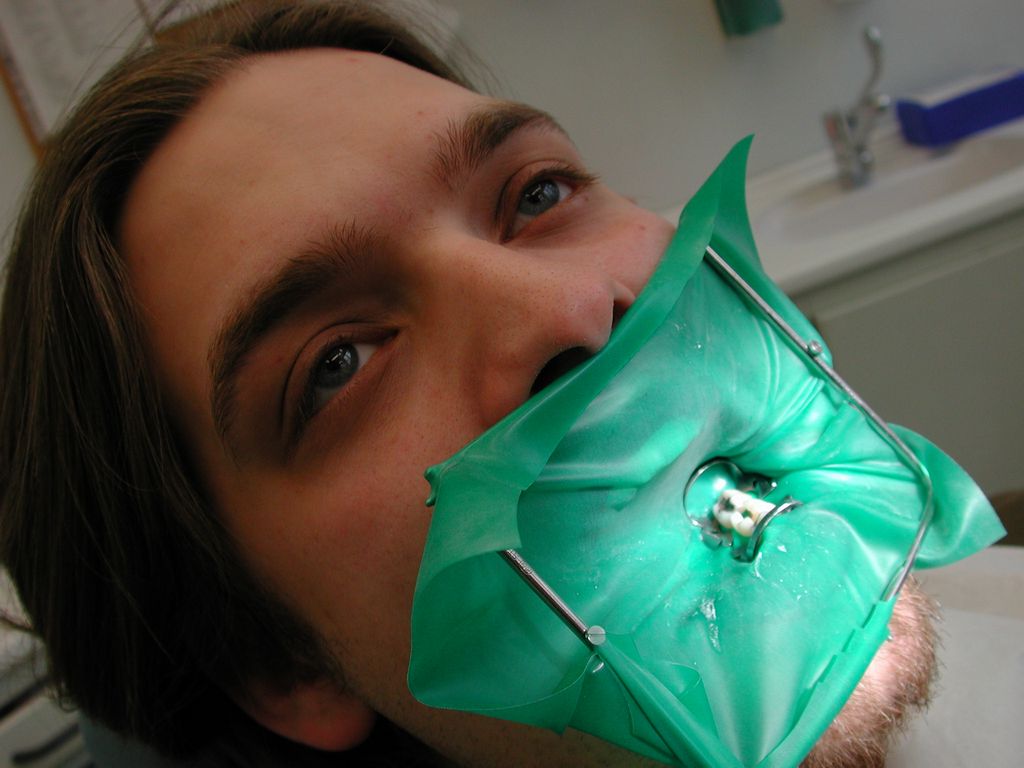
Remove all the infected/dead nerve and bacteria from within the tooth. This is aided using certain disinfecting chemicals. For this reason, during treatment you will have to wear one of these:


Apologies for the morbid expression on this gentleman's face, I imagine inside he is feeling pure joy. 

The green sheet/frame/silver clamp around his teeth is referred to as a "rubber dam" (referred to by my Dad for several months as "a Ramadan" - yes the famous Islamic period of fasting - because apparently "that's what it sounded like when the dentist explained it")

Wearing this device means that your mucky bacteria-containing saliva doesn't get inside the nice clean tooth and re-infect it. Similarly it means that whatever chemicals we use to make the tooth squeaky clean go nowhere near the inside of your mouth. It also makes the whole process a lot more comfortable. As you can see, you also look pretty glamorous.

2.
Shape the canal where the nerve resided to a nice even conical shape with no ledges where bacteria can continue to breed. This is done using an endodontic file. These come in many shapes and sizes. They may be held by hand, or be used in a machine.

3.
Fill the canal COMPLETELY. This is the tricky bit. As you can imagine these pesky canals are very small and in order to make sure the tooth does not become reinfected, the tooth needs to be cleaned and filled right to the end of the root. 

Maybe this picture will help. 

Pic


The picture above shows a tooth with 2 roots and 2 root canals. There are generally a set of anatomical rules for teeth and root canals however as with everything in the human body, this is open to a lot of individual diversity. 
For example, upper front teeth usually have one canal and it would be very unlikely to find a front tooth that varied from this rule. However, upper first molar teeth for example should technically only have 3 root canals (one for each root) but we often find that they have 4. Similarly, for lower molar teeth, these have 2 roots but 3 root canals. 
As you are beginning to see it is quite a complicated process. 

Root filling done, what happens now

Often comes the question of what should be done with the teeth following completion of the "root canal filling" bit. Again this varies depending on which literature you read. In fact there is such debate in this field (oh yes, quite the hot potato of the dental world) that even the Cochrane review on this topic concluded "there is insufficient evidence to support or refute the effectiveness of conventional fillings over crowns for the restoration of root filled teeth". Which basically means, no one can come to an agreement. 

What cannot be refuted however, is that the tooth needs to be adequately sealed after root canal treatment (fortunately a number of scholarly people agree with this - Saunders and Saunders 1994) and in fact even way back in 1990, Torabinejad and his friends found that it only took 19 days for the entire length of the root canal to be reinfected if an adequate filling was not placed following root canal treatment. 

What this means is plain English is that you can't get away with having a root filling done and then live with a naff temporary filling for several years, or in fact months. 
If your dentist is planning on placing a crown on the tooth (which is perfectly reasonable), ensure that a good quality filling is placed, this will not be soft or crumbly. If they give you a temporary crown while your permanent one is being made, it needs to fit well, and if it falls off it should be replaced or recemented immediately. 

Finally, whilst I say this is one of the 2 options for dead (non vital in science speak) teeth it does not guarantee 100% success. This means the following:

1) If your face resembles that of the elephant man, this means there is a whopping great infection at the root of the tooth, and while we could clean it and fill it to textbook perfection, the infection means there is a reduced chance of success
2) Even if you are the "perfect" candidate for root canal treatment (e.g. an infection caught early, nice wide root canals etc) and the root filling is a thing of beauty, this does not mean the tooth will last for the entirety of your days on the planet. At best it can extend the life of the tooth for several years. Some people are very lucky and it may even outlast your human self. Others sadly find it becomes reinfected down the line however at least it buys some time so you can save up for whatever tooth replacement option you fancy. 

"Lazy dentist syndrome"

As I mentioned above, canals are very tricky to negotiate and in some cases even find. Imagine the M6 on a Friday night at rush hour/that country pub in the middle of nowhere that you thought you would try and find. 

On an x ray rather than seeing a nice black line down the centre of the tooth/root as you can in the x ray I put up earlier, you may not be able to see anything. This is due to the fact that the canal(s) have "closed off" or become blocked due to a number of things such as the natural aging process, the infection itself, previous trauma etc. We call this "sclerosis". 

In these situations a specialist endodontist would be the absolute best person to treat you and a referal to such a person can be made by your dentist. 

Sadly I have encountered several patients referred to my place of work with canals the size of the channel tunnel because apparently "no one in the practice is qualified to do root canal", I would therefore suggest you raise the question "at what point was this removed as a necessary examinable requirement OF EVERY QUALIFYING DENTIST IN THE COUNTRY".  

I am not going to go into the many clauses and stipulations of the NHS contract as it is interpretable in many ways. Each dental practice will have their own rhyme and reason for treatments they provide. They may only provide root canal therapy on a private basis however every dentist is qualified to carry it out and in my opinion should at least provide you with an honest opinion and offer to "have a go" or show you on an x ray why they believe it is not feasible for them to attempt root canal (e.g. due to sclerosis). 


Final bit of advice

As you can see, I have been rambling on for many many lines now and could continue for many more about root canal treatment (because sadly I find this all very interesting) however my final pieces of advice are:

  1. Please don't wait until you are in agony to go to the dentist
  2. If your filling comes out with your bacon sandwich, it will not be fine, it is never fine, please go to the dentist to have it fixed
  3. Root canal fillings are an excellent treatment option and are frequently the only means of "saving your tooth"
  4. They however are not 100% in any cases because your tooth is already pretty messed up from the whole rotten tooth thing
  5. Therefore, please brush your teeth and keep the sugar exposures to a minimum. 
As always, ask ask ask away. If you have made it to this point I congratulate you. That's at least a years worth of lectures in one blog post. Maybe I could appeal to make it some sort of verifiable CPD......

References:


Fedorowicz Z, Single crowns versus conventional fillings for the restoration of root filled teeth.Cochrane Database Syst Rev. 2012 May 16;5

Saunders WP, Saunders EM (1994) Coronal leakage as a cause of failure in root anal therapy: a review. Endodontics and Dental Traumatology 10. 105-8

Torabinejad M. Umg B. Kettering JD  (1990) In vitro bacterial penetration of coronally unsealed endodontically treated teeth. Journal of Endodontics 16. 566