Sunday, 2 February 2014

Implants part 2. Prepare yourselves....

Part 2 Implant overview.

Hope you made it through the last without falling asleep/questioning why the hell you would read such a thing. This week’s post is going to detail a little more about the procedure of placing implants, long term care and general post implant placement information.

How long does the whole process take/what do I have to go through.

When answering this question there are various things to be considered, the main being whether or not the implants are placed and restored (i.e. placing of the crown or bridge or denture on top of the implant) in stages vs in one go.
I’m sure you will have all come across those adverts in the newspaper/the back of certain magazines that offer the operation to place the implant and then restoration of the implant in a day.
This is incredibly misleading, as it is virtually impossible to make a denture, crown or bridge to fit on an implant within a day, unless you have some sort of miracle lab and even then various impressions (moulds) need to be taken of your implants in order to get the best fit and appearance. If the dentist is just relying on one impression taken straight after the implants are placed when there is bleeding, swelling etc then it is highly unlikely that the crown/bridge/denture is going to fit, look good and work well. Thus if you went to a decent cowboy dentist they would require at least a couple of visits.
Now this only takes into consideration how it is going to look immediately. There is some debate within the implant community (a bunch of very cool people) about the length of time and number of stages that should occur for the best result.

ADI summarise this nicely.

“For routine cases, from the time of implant placement to the time of placing the first teeth, treatment times can vary between 6 weeks and 6 months. The availability of better bone can be used to decrease treatment time, whilst more time and care must be taken with poorer bone, which can therefore extend treatment times beyond six months”
They would class routine cases as simple tooth loss situations i.e. not following cancer treatment or illness, in patients with suitable bone.
When assessing all patients who are considering implants there is a basic structure of appointments etc that should be followed if you want to get the best out of the implants and not destroy your mouth.

Handy subtitle time…

Summary of stages for routine dental implants

Stage
Eh?
Other info – if you’re still with me
Diagnosis
Your current dentist may be the one who is offering to provide implants, in which case, they should be familiar with your mouth and hopefully should have been responsible for doing the groundwork for the time that you have been seeing them i.e. any fillings, treating gum disease etc. However different dentists will of course have different opinions and so if you are going to see an “implant specialist” in another practice, they may request that your own dentist carries out any dental repairs, filling replacements or extra courses of gum treatment. Hopefully they wont be pointing out anything too new and if they do i.e. “good GOD has a bomb gone off in your mouth”/ “you have RAGING gum disease” then you should perhaps consider finding a new general dentist.


Treatment planning
Treatment planning involves determination of where the implants are going to go. Certain things have to be considered at this point:
a.    Whether there is enough bone to support an implant
b.    Whether there is enough room to place an implant and its restoration (e.g. bridge, crown, denture)
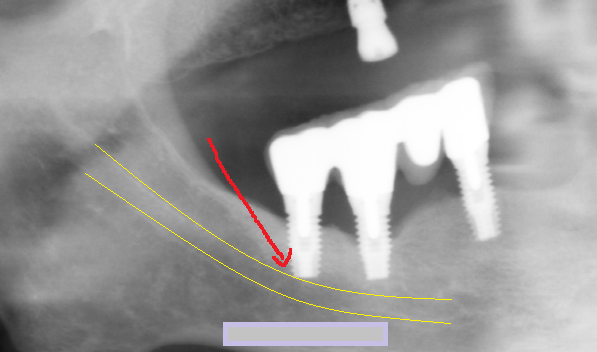
c.    Whether placing an implant is going to affect any important things in the mouth i.e. the sinuses/nerves. See some pictures below for this.
a + b
The amount of bone and the amount of space have to be considered in various different dimensions. There are also different considerations for each area of the mouth due to the force that teeth take depending on their position in the jaw. The best way to explain this is with pictures. See below.


 1)    Vertical dimension: think of it as height of bone/space between the teeth or space between the jaws


Now the above situation is only for front teeth which generally take a lot less force. Yes you use your natural teeth to bite into apples etc which technically you can do with implants but with the amount they cost per piece you’ll probably want to be cutting your apples up into pieces from now on.

So, for crowns towards the back of the mouth we need more space because the restorations have to be much stronger as the back teeth take significant grinding forces. For this reason we need at least 3-4mm space between the implant abutment and the opposing teeth.

In the picture below you can see that the space between the abutment on the implant and the top teeth is only just 4 mm. In this case this simply is not enough to make a decent white crown. The reason for this is that the white bit of the crown – the ceramic – has to be a certain thickness to a) look good and b) be strong enough. At less than an ideal than an ideal thickness will look like a grey blob and/or break and fracture as soon as you try and eat something. So for the picture below, the only option would be to place a full metal crown which can be made much thinner due to the increased strength of metal over porcelain.


The final set of considerations in terms of measurements is for dentures.  There should be 10–12 mm of vertical space between the implants placed in either the top or bottom jaw (or in fact both) in order to place good sized teeth  

If a bar is used for the denture to clip onto – as opposed to simply clipping into the top of the abutments, then this measurement must allow for a space of 2mm between the gums and the bar so that it can be effectively cleaned under.


The next measurement to consider is width of the bone, i.e. between the cheeks/lips and the tongue/palate. Obviously these measurements all depend on the size of implants the specialist is intending to use. 3.25 mm diameter implants are the smallest available, according to dentalcare.com, 6mm width of bone is the minimal thickness into which 3.25 and 4 mm diameter implants can be placed.  Larger diameter implants (5 and 6 mm) require at least 7-8mm. Although these measurements are large enough to accommodate an implant, it means that the implant can only be placed in one direction as there is limited bone either side of the implant. .


So, miles back, I also mentioned the importance of checking for vital structures.

1)    The sinuses.
These are the bits in your face that get really painful when you have a cold.


2)    Nerves
 

 Once all the above nonsense has been assessed, and any bone grafts or sinus lifts have been performed (which the specialist can explain in far greater detail using your own xrays/scans and fun models etc) then we can get down to the good stuff and actually put the damn implants in.

Stage
Eh?
Other info – if you’re still with me
Implant Placement
Drilling the implant into the bone and the gum

There are 2 different schools of thought as to how exactly this should go. Of course, the screw part of the implant goes into the bone, but there is some debate as to whether this screw should then be covered back over and allowed to heal completely hidden below the gum, OR whether an extra bit (an abutment) should be placed on top which pokes through into the mouth, and allow the gum to heal around this.

Time for some more pictures
Implant placement is usually followed by a period of healing lasting from 6 weeks to 6 months.
Stitches are normally removed 7 to 10 days after the implant placement.


 Generally, the process goes a little like this.

1)    Tooth extracted

a.    At this point if you had/have a whopping infection like an abscess then the area will be allowed to heal for a while as placing an implant into infection is like building a house in sand (and we all know how that song goes)
b.    After this healing, a space for the implant to go in will need to be made, unlike if the tooth is just removed and there is a nice space there from where the tooth was sitting
c.    If the tooth is just being taken out because of trauma/decay/gum disease then an implant can be placed into the socket straight away

2)    A hole for the implant to sit in is made in the bone. Generally there is already a “hole” from where the tooth was removed but this isn’t a standardised shape and so the area is shaped to fit the implant perfectly. 


 3)   It is at this point that the debate starts.

a.    Sometimes the implant screw is placed and then covered over and the gum is “sealed” with stitches
b.    Other times a “healing abutment” is placed on top of the screw which pokes through the gum. It looks like a small silver button on the gum in the mouth – lots of fun to scare children with.
                                          i.    After either a or b there is a period of osseointegration a.k.a integration of the implant with the bone of the jaw before any sort of crown, bridge or denture is placed on them. This allows for the implant to become more “part” of the jaw than a false object before you start expecting it to carry the weight of biting force.
                                         ii.    This process of osseointegration takes between 3 and 6 months depending what you read.
                                        iii.    During this time you will of course have a space where the tooth was. If you had coped fine with this space before seeking an implant then you can carry on with a space, however if you have had the tooth taken out or it has been knocked out in fact then you may not fancy walking around with a gap. The only realistic option is a temporary denture which will replace this missing tooth. Sadly it is a reality that if there is any period of time of healing then you will need a temporary option to fill the space and you just have to accept this I’m afraid.
c.    The implant, abutment and temporary version of whatever the final restoration is planned to be is placed straight away. The temporary version is not in the bite, i.e. there is a gap between the teeth so that biting forces are not applied to the implant while it heals. This of course means that you have a nicer option than a temporary standard denture but it will not be the final object and you will have to go back in a few months to have this done.
d.    Of course the above point is irrelevant if the decision is made to place the implant, abutment and final restoration i.e. crown/bridge/denture immediately. Of course this sounds like the ideal option. Minimal time spent, it’s what they use on those 10 years younger programmes so it must be good etc however it does not allow any time for this “osseointegration” before you are expecting a false titanium screw to stand up to the forces you apply when chewing through an overcooked steak. Imagine trying to walk on a hip replacement within hours of it being placed. You just wouldn’t and the same usually applies with dental implants but as with everything there are differing schools of thought.


Why you SHOULD wait?
Why you SHOULDN’T.
A study by Adell et al. 1981 conclude that loading i.e. allowing the implant to take biting forces straight away after placement can interfere with healing. Ideally, we want bone to form all the way around the implant so that it becomes almost part of the jaw. If biting forces are applied to the implant too soon, the implant moves within the jaw (only minimal amounts like vibrations) meaning that instead of bone forming around the implant, soft squishy stuff forms instead –like when you pick off a scab too early and this inevitably will lead the implant to fail.
Studies have found that immediate implant loading achieved similar success rates as those reported in the delayed 2-stage approach therefore, who cares about all the theory.

Covering over the most important bit of the dental implant – the actual implant bit, allows for safe healing and protection of it from all the bacteria in the saliva.
If the implants are to be placed in the lower jaw, then there is more chance of success with immediate placing of the final crown/bridge/denture

Some research suggests that GENTLE loading of the implant right after placement actually helps the strength of bone healing around the implant, a bit like gentle exercise after any operation will help with healing.

Stage
Eh?
Other info – if you’re still with me
Healing
As mentioned above, this takes around 3-6 months
During this time you will probably be going backwards and forwards to see whoever placed the implant(s) to  check healing, check how the gum is forming around the implant and to make any adjustments to temporary dentures etc
Restoration
This is the placing of the final crown, bridge or denture on top of the implant.

Looking after the damn things
It is important to again reiterate that dental implants are not natural teeth. They don’t act in the same way, they don’t fail in the same way. It is also worth noting that when an implant fails, it is really bad. If a tooth breaks or has to be taken out, then usually its just the tooth that’s the problem.
According to Carl Misch, DDS, MDS (lots of letters after his name so he must be important) “when the implant fails, it also destroys the bone around the implant” often to the point where the whole plate of bone in front of the implant (the bit that you can feel under you gum) is completely lost
Similarly,  “if that implant happens to have been placed on a bone graft, this means that this particular implant failure could result in insufficient bone to re-implant” i.e. there’s sod all that can be done if it fails.
It is worth mentioning at this point that dental implants don’t last forever. They have a life span just as hip replacements, boob jobs etc do. If you look after them well i.e. keep them clean, have regularly checks with your dentist and hygienist visits, don’t smoke, have ideal medical fitness then you could be looking at 20 years. HOWEVER during this time you will likely have to have the crown/bridge/denture on top of the implant modified as they will get worn or damaged by eating and so on.
.


 So, in summary,
1)    Don’t smoke
2)    If you have gum disease, don’t even think about asking for an implant
3)    If you want a quick fix, implants are not for you. Similarly if the thought of having a scalpel/bone drill coming at you makes you feel sick/dizzy then implants are not for you
4)    If the thought of having a denture puts the fear into you, then again, implants are not for you. In 99% of cases you wear a short term denture while the area of infection after taking the tooth out heals, or while the implant heals
5)    If you have no bone, you can’t have an implant unless you are suitable for bone grafting which takes time, effort, money and could potentially also fail.
6)     Go and see a specialist who knows what they're doing and can fix problems if/when they arise

I realise this was probably very hard going on the reading front, and admittedly it was probably written more for my benefit of learning through researching but maybe it will help someone!

As always, if you have any questions please feel free to ask. Finally, apologies for the varying fonts used on the pictures, I think I may have been losing the plot as I neared the end. 


Stuff I looked at
Gapski R, Wang H-L, Mascarenhas P, Lang NP. Critical review of immediate implant loading.  Clin. Oral Impl. Res, 14, 2003; 515–527
Adell, R., Lekholm, U., Rockler, B. & Bra˚nemark, P.I. (1981) A 15-year study of osseointegrated implants in the treatment of the edentulous jaw. International Journal of Oral Surgery 10: 387–416
Bra˚nemark, P.I., Adell, R., Breine, U., Hansson, B.O., Lindstrom, J. & Ohlsson, A     1969 Intra osseous anchorage of dental prosthesis I: Experimental studies Scandinavian Journal of Plasticand Reconstructive Surgery 3: 81–100.

http://www.drchetan.com/dentalpics/plog-content/images/dental-instruments/dental-implants/dental-implant-14.jpg

Sunday, 19 January 2014

“What about them implant things?”


Today’s blog post is going to be an overview of dental implants. I won’t go too much into specifics of types, the science etc because it’s a bit irrelevant, many boffins in many Scandinavian labs have done all the work for us and also, I  have no idea what half of the publications related to said science are on about.

I will split the topic into 2, what they are and what they can be used fo and in whom, then will do a part 2 explaining what is involved in their placement, aftercare, lifespan etc so stay tuned for that!

Shall we begin? Good.

What are they?

The Association of Dental Implantology UK (ADI) define implants as “a substitute for a natural root and commonly it is screw or cylinder shaped”. The actual object called the "dental implant" refers to the bit that is in the bone. Other components can be added/ attached to make the implant functional, for example, something called an abutment can be screwed on top, which passes through the gum and allows prosthetic (fake) teeth to be attached. See helpful pictures below.


Why would you need them?

So, you find yourself in the situation where you are either already missing, or are about to lose either 1 tooth e.g. you got caught in a drunken brawl, you ate too many sweets or in fact several teeth, for instance due to dental disease or following trauma (often horse related) or after removal of tumours etc. 

Placement of implants after cancer surgery is much more involved because not only are the teeth often missing, but the disgusting thing takes most of either one or both jaw bones with it and so extensive rebuilding is necessary before implants can be placed therefore making it much more complicated and beyond my limited realm of knowledge and so we shall stick to the “I haven’t brushed my teeth for 20 years and would now like you to fix it for me” causes of tooth loss.

How do they work and what can they be used for?

This seems a fairly obvious question however there is a lot of confusion of what implants can do. They are the closest thing to a natural tooth that can be provided by a dentist however they have several limitations. They can be used to replace individual lost teeth, in the majority of cases this is front teeth.

There is a lot of panic about losing and replacing of back teeth. Obviously if you have one of those smiles that shows every single tooth in your mouth and beyond, or have one of those laughs where you can see your epiglottis then the concern about missing a tooth is understandable. Fortunately most people don’t have this problem and so if you lose a molar tooth, there is actually no need to replace it. Especially with something that costs a minimum of 2 grand.

***As a side note if you come across one of those adverts promising 15 implants for the cost of a Mars bar, I would stay well away. I would consider dental implants in the same way you would think about other implants – hip replacements, breast implants etc and if you wouldn’t go to a rat infested converted house to have those done on the cheap, then you shouldn’t have your teeth done in the same situation. I think because they’re teeth people believe that the same standards are care aren’t necessary, only takes 5 years to be a dentist and that, surely my beautician could do it? The answer is no. Obviously. Mainly because if something goes wrong, its’ your jaw and your head. There is limited bone and so any infection caused by dodgy placement (bearing in mind there is a risk of infection even under pristine surgical conditions and a skilled operator) means that you are at risk of losing significant portions of your jaw bone and at this point, we can’t fix it. Mini rant over. Let’s continue

The only feasible reason for replacing a missing back tooth is to stop over-eruption of the opposing tooth, that is to say when the tooth that is biting against the one that is lost grows out of the gum and into the space. It is a very rare case that a tooth in the mouth ONLY comes into contact with 1 other tooth when biting, usually they touch 2 or 3 depending how you bite and for this reason usually over-eruption won’t occur.
Let’s see if a picture helps…


 Over-eruption means that the bit of the tooth that usually sits under the gum line is now exposed to the mouth. In terms of potential consequences this can look a bit unsightly, but again it would depend on your smile and what is shown. If you only see it in the mirror when you’re looking at a demented angle whilst stretching out your cheek then it really won’t affect your life. The other potential problem is that the bit of tooth under the gum line doesn’t have the protective enamel layer and so can be sensitive but again this can be dealt with in other ways that doesn’t involve damaging any teeth by placing bridges or burning a hole in your wallet.

Implants can also be used to replace multiple teeth either as a way of acting as an anchor for a bridge, which thus will replace 2 teeth, or to have several implants to more effectively hold in a denture.

Implants are NOT used to replace every tooth in the mouth. If you have no teeth left, then you need a denture. End of. The stabilisation of a denture CAN be improved by implants.
I emphasise word can for the following reasons. Fortunately some clever people have done some research so I can insert that now…
Assunção et al found that “Although the stability of the mandibular (lower) implant-retained denture was enhanced compared to a conventional denture, the quality of life and satisfaction levels were similar for both the groups.” i.e. the groups of people with and without implants felt equally happy (or in fact unhappy) with their dentures.

Allen et al found that “Subjects who received implants that replaced conventional complete dentures reported significant improvement after treatment, as did subjects who requested conventional replacement dentures” i.e. simply having some sort of denture was more important/life changing than having implants to hold a denture in.
Basically, implants are not the be all and end all of tooth replacement.

So, that’s what they can be used for, how about what they actually are.


For this reason, one of the risks of having implants placed is that if they fail, it is often due to damage to the bone surrounding the implant rather than the implant itself as the metal implant is far stronger than the bone it is encased in and in a fight, the weaker one loses. This is the same reason by post crowns fail – the post is stronger than the tooth it is stuck in, so rather than the post breaking, the tooth does instead.

I will go into this more in the second part of this blog.

Multiple implants to stabilise dentures work in a similar way but takes slightly more careful assessment as it is not a case of plonking an implant in where a tooth has come out. The position and placement of the implants in order to best retain a denture has to be worked out and will be different in every person.


As you can see from the above pictures, this particular patient has 4 implants. They can be left as the implants alone onto which the denture clips. Or the implants can be connected with a bar and the denture clips onto this. Sometimes fewer implants will be placed etc etc and this will all be decided by the implant-surgeon.

Below you can see how denture clips into the implants. This particular case does not have a bar whereas the one above does.


In the final bit of this blog post I will quickly go over who is not suitable for implants. Of course you will most likely be able to track down someone somewhere who will place the implants without asking questions. As I said earlier, if you like taking risks with your health and in fact life, go ahead. If not, go to someone who actually knows what they’re doing who will tell you the following.


Contraindication
Why

Smoking

Smoking reduces blood circulation in the mouth and suppresses the immune response in the mouth, what this means is that healing in smokers is crap. As healing is necessary for implants to work (as the bone needs to fuse around the implants) it is highly reduced in smokers. Thus infections and fusing of the implants is highly reduced.
You may also experience more pain from the procedure and this pain could last for longer. It is also possible that the implant will never heal and this could leave you in constant pain, resulting in the removal of the implant. Finally, long-term smoking affects how dense the bone is meaning that finding suitable strong enough jaw bone is more difficult.
High alcohol use
Alcohol, like smoking, seriously affects healing and thus can lead to implant failure.
Gum disease
Number one, gum disease can destroy bone. No bone = no implants. Simples. Even if enough bone is found to put an implant in the first place, gum disease will inevitably lead to its failure through the same bone destruction.  
Clenching and Grinding teeth
As briefly mentioned above, the implants are not natural shock absorbers like teeth are and so any excess force, like clenching and grinding of the teeth, can damage the crown on top of the implant and potentially the base of the implant as well just as clenching and grinding can damage natural roots.

Weakened Immune System


Implant placement requires an operation. While it is a relatively minor operation, any reduction to the immune system normal responses can lead to infection. Weakened immunity can occur naturally with age, due to chemotherapy, AIDs, cancer, steroid therapy, medication following transplants, Diabetes etc. Of course this will be discussed during consultation and whilst having these conditions/taking those meds does not completely rule you out from having implants, certain modifications to treatment might have to be made

Bisphosphonate Medication


Bisphosphonates are a type of medication taken mostly for osteoporosis, but also for conditions such as Paget’s disease, bone cancers, metastatic cancers. They basically alter the way that bone heals and for that reason, anything that “damages” the bone in patients taking these medications can lead to devastating infection.
Unsuitable bone
For example very thin bone. While it is possible to bone graft, move the sinus to create more space etc this is far more extensive treatment. This is particularly irritating when people come in, you tell them they need a denture, or that we cannot fix their dentures to make them like normal teeth. The automatic response of the patient being “what about them implants?”. If you have enough teeth missing to need a denture, you need a denture. If your dentures drop out because you have no bone left, you can’t have implants without a whole tonne of extra surgery.

.
So that’s all for today folks!!!

Feel free to ask any questions and remember to check back in a couple of weeks for details of exactly what is involved in implant placement and sadly, things that can go wrong!!

References and that..
Allen, McMillan, Walshaw,  A patient-based assessment of implant-stabilized and conventional complete dentures The Journal of Prosthetic Dentistr Volume 85, Issue 2, February 2001, Pages 141–147
Assunção WG, Zardo GG, Delben JA, Barão VA. Comparing the efficacy of mandibular implant-retained overdentures and conventional dentures among elderly edentulous patients: satisfaction and quality of life. Gerodontology. 2007 Dec;24(4):235-8.
Chee & Jivraj  Failures in implant dentistry British Dental Journal 202, 123 - 129 (2007) 
http://www.philipfriel.com/implant-retained-dentures-gallery.html
http://kumarandentalclinic.com/Missing%20Tooth.htm
http://www.philipfriel.com/implant-retained-dentures-gallery.html


·   

Sunday, 5 January 2014

Sedation


“Can’t you just put me to sleep to do that?”


Try to stay awake for this week’s topic…sedation. Insert drum and symbol noise here post awful joke.
There is a lot of confusion over methods of pain and anxiety relief used by dentists. This mainly comes from back in t’ day when regular high street dentists, officially known as General Dental Practitioners or GDP’s happily knocked people out to carry out dental treatment.
In 1998 the General Dental Council acted to construct more stringent standards for the use of general anaesthetic for dental treatment as sadly, several people popped their clogs in the dental chair. It endorsed the need for Conscious Sedation provision rather than the continuing provision of General Anaesthesia as a demand led service i.e. for everyone who came in needing a tooth out, a filling, a check up, would no longer automatically receive general anaesthetic as standard.
Although the publication of the GDC regulations  was followed by a substantial reduction in the use of general anaesthesia for dental treatment, two further deaths occurred outside hospital following general anaesthesia for dental treatment. Following several more rather tedious but nevertheless important reports, a final set of regulations were developed which state that “by 31 December 2001, all general anaesthesia for dental treatment should be administered in a hospital setting with critical care facilities.
This led, positively, to an increase in the use of sedation. Sadly, the dentists of yesteryear – yes even as recently as 2001 – were not so good on the communication front and either through this or through lack of knowledge themselves did not adequately explain to patients the difference between general anaesthetic, aka being knocked out, being put to sleep, and sedation.
For this reason we still on a daily basis see patients booked in on clinics to receive sedation for their dental treatment who either a) are unsuitable for sedation (I will explain further below, these people are usually weeded out at the consultation appointment but some still manage to wiggle through the net) OR b) believe they are going to be asleep i.e. have general anaesthetic for the procedure,
Why does it matter? I hear you ask. Well in some cases you are right. Why some people feel the need to be asleep to have a filling when others will happily have half their face hacked off without even a local anaesthetic is a mystery however our friends at the GDC state “dentists have a duty to provide and patients have a right to expect adequate and appropriate pain and anxiety control”. In some cases, due to general or mental health issues, or in fact the nature of the dental procedure alone, local anaesthetic simply is not enough.

Therefore there are several options ON TOP OF local anaesthetic than can be considered. The reason I slipped onto the old caps lock button is because sedation is not the be all and end all. It helps you relax, stay calm, prevent certain stress-related illnesses from escalating during treatment, it does not however provide complete pain relief and so local anaesthetic – yes the one via the needle – is still vital and patients need to be made aware of this otherwise you will find yourself in front of the not-so-friendly GDC being accused of assault.

How we can help

Here is the wordy bit. In order to eliminate confusion caused by the aforementioned poor communicators, we now refer to sedation as “conscious sedation” purely because you remain fully conscious for the entire time. Yes that’s right, you are not asleep, in a coma, and in fact remain fully in control of your body movements including the very important (if not slightly annoying) gag reflex, ability to open and close the mouth etc.

Here is exactly what I said above but in nice technical terms;
“conscious sedation is a technique in which the use of a drug…produces a state of depression of the central nervous system enabling treatment to be carried out, but during which verbal contact with the patient is maintained throughout the period of sedation. The drugs and techniques used to provide conscious sedation for dental treatment should carry a margin of safety wide enough to render loss of consciousness unlikely.”

Delivery of conscious sedation comes in several forms – inhalation i.e. you breathe in the drug, or intravenous i.e. the drug is given directly into the bloodstream.

Inhalation Sedation

The drug you inhale is the same thing they give pregnant women when giving birth – laughing gas known as Nitrous Oxide. This chemical has the added quality over intravenous sedation of providing pain relief when inhaled. The American Academy of Paediatric Dentistry (AAPD) helpfully describe it as a colourless gas with a faint, sweet smell. It is an effective analgesic (pain relieving)/anxiolytic (anxiety relieving) agent causing central nervous system (CNS) depression and euphoria with little effect on the respiratory system. Translation: it makes you calm and happy without compromising any breathing reflexes or causing harm to the lungs or airways which is particularly important in people with things like asthma, where irritation of the airways can cause problems.


Pros
Cons
Quickly excreted from lungs – so effects wear off rapidly
Need for flow of pure oxygen after delivery of nitrous oxide as it leaves the blood stream much quicker than oxygen can replace it. Not really a disadvantage as 100% oxygen feels awesome and is automatically available wherever inhalation sedation is being given
No airway irritation
Feeling of loss of control
Nitrous oxide is absorbed rapidly, allowing for both rapid onset (two to three minutes)
You have to wear a mask in order to breathe the gas, anyone suffering from claustrophobia may struggle with this
It causes minimal impairment of any reflexes, thus protecting the cough reflex however has the added benefit of reducing very strong gag reflexes allowing certain treatment to be carried out that otherwise the patient may not be able to tolerate e.g. impressions
You need to be able to breathe through your nose, therefore if you have trouble with this e.g. broken nose, a cold, then you are unsuitable for this type of sedation
Extremely safe when used correctly
For the same reason as above, if treatment required needs us to be near your top front teeth, the mask gets in the way and so is not suitable
Extremely effective at reducing anxiety/ increasing tolerance to dental procedures particularly long or more difficult treatment.
It does not work alone. That is to say, the drug is not powerful enough used by itself to relieve all anxiety. It requires reassurance and “behavioural management” to be effective.


Who is it suitable for:

1.    Anxious patients. It is important to ascertain the reason for anxiety. As I mentioned above, it is still necessary to have local anaesthetic injections (yes, the dreaded needle) with ALL types of sedation and so while you care less when you under conscious sedation, if the fear of needles is extensive then the patient will be unsuitable for treatment under sedation.
2.    A patient whose gag reflex interferes with dental care;
3.    Patients where good, effective local anaesthesia cannot be achieved e.g. heavily infected teeth, low pain threshold
4.    A cooperative child undergoing a lengthy dental  procedure.
5.    Patients will well controlled diseases that can be worsened by stress e.g. angina, asthma

Contraindications for use of nitrous oxide/oxygen inhalation may include:

1.    some patients with chronic obstructive pulmonary diseases (COPD) – certain tests will be performed before placing a patient on a list for inhalation sedation, and the results of these tests will determine whether or not patients are suitable
2.    severe emotional disturbances. As mentioned above, the inhalation sedation does not work alone in reducing anxiety or making a patient feel like what you are about to do to their teeth is within the realms of something they can tolerate. Certain mental health disorders are too difficult to manage using the techniques of inhalation sedation
3.    drug-related dependencies. This includes alcohol as the metabolism of the drug, i.e. the way it works is affected heavily by certain drugs and alcohol.
4.    first trimester of pregnancy. Ideally we avoid inhalation sedation but it is still preferred over general anaesthetic so it is taken on a case by case basis.
5.    Severe heart disease, again, as with the respiratory problems, the results of pre-op tests will give us an idea of the level of disease and therefore whether sedation is appropriate
6.    Blood problems – Including factor deficiencies e.g. haemophilia, nutrient deficiencies e.g. anaemia
7.    As mentioned before , anything that prevents or makes it difficult for a patient to breathe through their nose which could be as simple as a current or recent cold.  


Now we have gone through all that, which involves enough paperwork to fell a small forest, if you are deemed suitable for sedation there are certain things that you must or must not do.

Oh by the way, this is what it looks like


See, even children can do it. You just breathe in through the nose, and out usually through the mouth because it is open for us to do the treatment. It is quite tight fitting and you feel a bit like a horse with a nose bag, but you are being pumped with the wonder that is nitrous oxide, so you couldn’t care less.
Some people would describe the feeling of receiving the sedation as like “being a bit drunk”. As a health professional I of course cannot comment on this but a friend told me a the warm glow after a few glasses of wine comes pretty close to the feeling of sedation.

Dos and Don’ts

  1. Don’t starve but don’t stuff yourself either. Some people say that inhalation sedation makes them feel a bit sick and a full stomach won’t help with this feeling. A light meal a few hours before treatment is perfect.
  2. A responsible adult escort must accompany the patient home from the dental surgery and assume responsibility for the patient’s post-sedation care.
  3. Wherever possible arrangements should be made for the patient and escort to travel home by private car or taxi rather than public transport. Where this is not possible, the escort must be made aware of the added responsibilities of caring for the patient during the journey home.
  4.  No alcohol 24 hours before AND after the sedation.
  5. Take your regular medication as  normal as this will have been factored into the decision of whether you a patient is suitable for sedation and so there is no need to stop if you have been deemed appropriate.


Intravenous Sedation

This involves use of drug called Midazolam, and less frequently Propofol.  This I suppose could be considered as a slightly stronger form of conscious sedation and is often the culprit which causes confusion between sedation and general anaesthetic. The drug/magic potion is given via a cannula in the back of the hand/inside of the elbow which is the same as with general anaesthetic, hence the mix up.


Despite the needle only being present for a matter of seconds, a severe needle phobia will also rule out intravenous sedation alone. As with inhalation sedation, local anaesthetic injections will also be required after the sedation agent is given. Usually by the point people are happy for you to take a pneumatic drill to their face but the inserting of the cannula on someone particularly anxious can be very stressful and if this is the case then they are unsuitable for this form of anaesthesia. In some cases, inhalation or oral sedation (a tablet) can be given prior to the insertion of the cannula and this can often be enough to alleviate the patient’s worries about needles enough for sedation to be given.

Because of the drug given for IV sedation, there are a few more contraindications for this type of sedation vs Inhalation.
The same reasons for giving inhalation sedation also apply for IV sedation however a few more can be added, for example, patients suffering from epilepsy or Parkinsons disease would benefit from treatment under IV sedation as the drug given for sedation has strong action against involuntary movements for instance those that occur during an epileptic seizure.

Who IV sedation is NOT suitable for.

1.    Very young or very old patients. The reason for this is that the drug is broken down by the liver, kidneys etc and if these are not functioning at the correct level the patient can have a very unpredictable level of sedation. The same applies for patients with severe liver or kidney disease (including alcoholics who may have a poorly functioning liver without knowing it)
2.    Pregnancy (you literally cannot do ANYTHING fun when pregnant)
3.    Severe hormone issues e.g. thyroid disease, poorly controlled diabetes, adrenal insuffiency treated with steroids

Whilst this does not rule out patients from receiving IV sedation, certain medications amplify the effects of sedation and so the delivery of the drug will need to be modified. The list of drugs is fairly extensive but includes:
1.    Antihistamines (e.g. for allergies including hayfever)
2.    Antihypertensives (blood pressure)
3.    Alcohol
4.    Opioid drugs  – the legal or illegal kind
5.    Anti epileptic drugs – because they often have the same action as midazolam used for sedation
6.    Anti depressants
7.    Obesity. For several reasons.
a.    Finding a vein
b.    Unpredictable metabolism (breaking down and using )of the drug by the body
c.    Difficult monitoring of breathing rate, heart rate etc which is VITAL throughout sedation
d.    Difficulty in treating medical emergencies e.g. if CPR is required
8.    Blood disorders – haemophilia, thalassemia, sickle cell anaemia etc

IV sedation makes you feel a bit more drunk than with inhalation sedation, but again, all within the boundaries of the nice happy warm place before you decide late night karaoke/snogging your boss is a good idea.
The added benefit of IV sedation is that is SOME people it causes loss of memory for the time that the sedation was given. Whilst this is beneficial sometimes because it means the patient may not remember a possibly not so nice bit of dental treatment, it also means that the patient may not remember how well they coped/how calm they felt, and so every time they have sedation, their fears remain the same because it feels like the first time even after 50 attempts. I must stress that whilst this amnesia occurs a lot, it cannot be promised, and some people remember everything.  

The Dos and Don’ts remain relatively the same. No alcohol. Escort is required. However because IV sedation takes much longer to wear off and be completely eradicated from the body, extra care has to be taken for 24 hours. This means no signing of important documents, no cooking (beyond a microwave ready meal), no looking after children, no driving. Therefore, the responsibilities of the escort that a patient chooses are greater than with inhalation sedation.
As with inhalation sedation, starvation is not recommended before IV sedation however we recommend not to eat for 2 hours prior to Midazolam sedation, or 6 hours before use of Propofol.

Again, whilst there seems to be a long list of dos and don’ts in summary. Conscious sedation implies that the patient has:
• Minimally depressed consciousness
• Ability to maintain open airway
• Protective reflexes maintained

• Response to physical and verbal stimulation (European Archives of Paediatric Dentistry)


i.e. YOU ARE NOT ASLEEP. NOT EVEN A BIT. NOPE. NOT EVEN DOZING.


Sedation is an extremely useful tool in treating lots of different people for lots of different reasons. For most of us it is given as an option for taking out wisdom teeth because this can often be a more extensive procedure than having a scale and polish so do not be afraid to ask to be referred for it!

Where I borrowed stuff from

General Anaesthesia for Dental Treatment in a Hospital Setting with Critical Care Facilities, Chief Dental Officer, 31 May 2001
GENERAL DENTAL COUNCIL, Maintaining Standards, paragraph 4.8
Scottish Dental Clinical Effectiveness Programme Conscious Sedation in Dentistry Dental Clinical Guidance Second Edition